If you have ever bitten into a warm, freshly fried mandazi and thought this could use a little something extra, lemon is your answer. This lemon mandazi recipe takes the beloved Kenyan classic and turns it into a treat. It gives it a bright, citrusy lift that makes every bite feel lighter, fresher, and honestly, a little addictive. The kind of mandazi that disappears from the plate before you have even poured your tea.
East African Mandazi has been a staple on the table for generations, fried golden, dusted with a whisper of sugar, passed around at breakfast, tea time, and everything in between. But this lemon version? It adds a zesty twist that balances the soft, pillowy dough with a gentle tang, keeping you reaching for one more.
The best part is that you do not need any fancy equipment or hard to find ingredients. Just a bowl, a rolling pin, a pan of hot oil, and one fresh lemon. Whether you are making these for a lazy Sunday breakfast, a family gathering, or simply because a mandazi craving hit at 3 pm (no judgment), this recipe delivers every single time. Soft on the inside. Golden and slightly crisp on the outside. Fragrant with real lemon zest. These are the mandazi you’ll be making on repeat.
Let get into it.
What Is Lemon Mandazi? A Kenyan Classic with a Citrus Twist
Lemon mandazi is a variation of the traditional East African fried dough, soft, golden, and lightly sweetened, infused with fresh lemon zest and juice for a bright citrus flavor that cuts through the richness of the fry. It is one of the most beloved Kenyan teatime snacks, and the lemon version has quickly become a favorite for anyone who wants a little more personality in their dough.
The Origins of Mandazi on the Swahili Coast
Mandazi traces its roots to the Swahili Coast, the stretch of East Africa that spans coastal Kenya and Tanzania, where centuries of trade between Arab merchants, Indian traders, and local Swahili communities produced one of the world most quietly remarkable food cultures. Spiced fried doughs arrived through those trade routes, met the abundance of coconut palms and cardamom on the coast, and became something entirely their own.
By the time mandazi spread inland across Kenya, it had already become a household staple. Families shaped it into triangles, circles, or quarters. Some added coconut milk. Some leaned into cardamom. Others kept it plain and simple. What stayed constant across every variation was the role mandazi played at the table, a warm, unpretentious companion to a cup of chai, morning or evening, without exception.
Today, mandazi is recognized far beyond East Africa. Food creators from the Kenyan and Tanzanian diaspora have introduced it to global audiences. Searches for East African recipes have grown steadily year over year, a quiet testament to how deeply this humble fried bread resonates once someone tries it for the first time.
Why Lemon Makes Mandazi Even Better
The classic mandazi is delicious precisely because of its restraint, lightly sweet, subtly spiced, never overwhelming. But that same restraint leaves room for something extra, and lemon fills that space beautifully.
Fresh lemon zest carries volatile oils that release their fragrance the moment they hit warm dough. That citrus aroma lifts the whole eating experience before you even take a bite. Then the lemon juice, just enough to add a gentle tang, balances the sweetness and keeps the flavor from feeling heavy. The result is a mandazi that tastes lighter, brighter, and somehow more refreshing than its classic counterpart, even though it comes out of the same hot oil.
There is also a textural argument for lemon. The slight acidity in fresh lemon juice interacts with the baking powder in the dough, enhancing the rise and yielding a softer, more tender crumb. It is doing quite a bit of structural work while you think it is just there for flavor.
If you enjoy baking with yeast and love doughs that are soft and pull apart tender, you might also appreciate these soft, sweet dinner rolls, a one bowl recipe that delivers the same comforting, pillowy texture to the table.
How Lemon Mandazi Differs from Classic Kenyan Mandazi
At their core, lemon mandazi and Classic Kenyan Mandazi share the same foundation: flour, sugar, a leavening agent, fat, and liquid, fried in hot oil until golden. The difference is in the flavor profile and the experience they create.
Classic mandazi is warm and neutral, spiced most commonly with cardamom or cinnamon, and designed to play a supporting role alongside chai, stews, or savory dips. It does not compete with what it accompanies. Lemon mandazi, by contrast, has its own distinct presence. The citrus makes it more assertive, something you eat and notice, not just something you eat.
Texturally, a well made lemon mandazi tends to be slightly softer inside because of the acidity in the juice working with the leavening. The outer crust still crisps up in the oil. Still, that contrast between crisp exterior and tender, lemon scented interior is what makes this version so satisfying on its own, no chai required, though it certainly does not hurt.
The shaping is identical. Triangles remain the most common cut across Kenya, though circles and squares appear, depending on the household. What changes is everything that happens after the first bite, and with lemon, that first bite tends to earn a second one almost immediately.
For anyone who grew up eating classic mandazi and has never tried the lemon version, think of it the way you would think of a familiar bread recipe made with one unexpected ingredient that changes the whole character of the bake, same comfort, sharper personality.
Ingredients You Will Need for This Lemon Mandazi Recipe
Good mandazi starts long before the oil heats up. Every ingredient in this recipe has a job, and understanding what each one does makes the difference between mandazi that turns out right the first time and dough you have to troubleshoot halfway through.
Yields: 16–20 pieces depending on shape size Prep time: 15 minutes Cook time: 10 minutes
Ingredients:

-
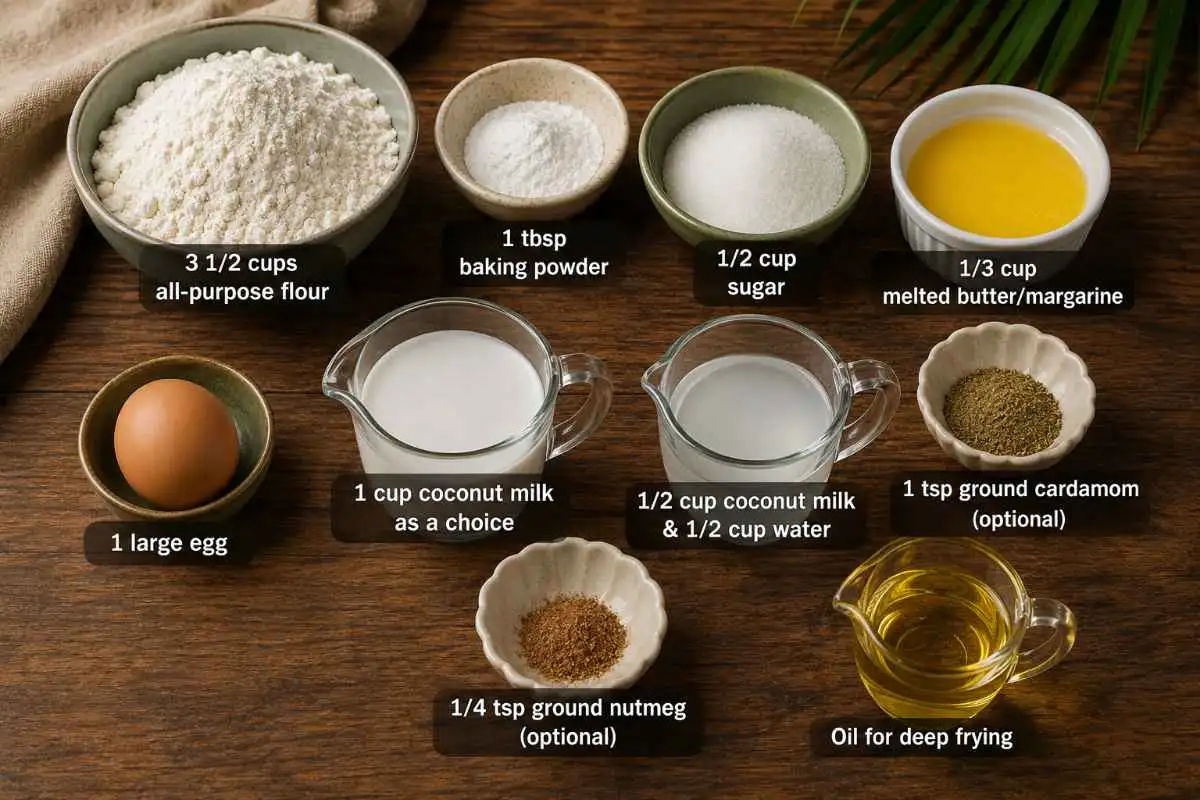
4 cups all-purpose flour plus extra for your work surface
-
1/2 cup sugar (adjust up or down to taste)
-
3 tbsp baking powder
-
1/2 tsp salt
-
Zest of 1 fresh lemon
-
Juice of 1/2 a large lemon
-
1/2 cup of melted butter or ghee
-
1 large egg
-
1 cup warm coconut milk (or regular whole milk, adding a splash more if needed)
-
Vegetable oil for deep frying
Key Ingredients and What They Do
Flour is the foundation. All purpose flour gives lemon mandazi its structure and enough strength to hold its shape during frying without becoming tough or dense. Sifting or whisking the flour before mixing aerates it, helping the dough absorb the wet ingredients more evenly and contributing to that soft, light interior.
Sugar does more than sweeten. At the right quantity, it tenderizes the dough by competing with the flour proteins for water, limiting gluten development, and keeping the crumb soft rather than chewy. Too little and the mandazi tastes flat. Too much and it browns too fast in the oil before cooking through.
Lemon zest is where the real flavor lives. The zest contains the essential oils of the lemon, far more concentrated and aromatic than the juice alone. When rubbed into the dough, those oils coat the flour particles and distribute fragrance throughout every bite. This is the ingredient that makes lemon mandazi smell as good as it tastes.
Lemon juice adds brightness and mild acidity. That acidity reacts with the baking powder, helping the dough rise and contributing to a lighter, more open crumb. It also balances the sweetness so the mandazi finishes clean rather than cloying.
Fat, whether butter, margarine, or oil, coats the gluten strands and keeps the texture tender. It also carries fat soluble flavor compounds from the lemon zest deeper into the dough, amplifying the citrus presence throughout rather than just on the surface.
Baking powder provides the lift that makes these mandazi puff in the oil. Without enough leavening, you get flat, dense dough. With too much, the mandazi rises too fast, splits unevenly, and collapses. The balance matters.
Salt is a flavor amplifier. A small pinch sharpens every other ingredient, the lemon becomes more vivid, the sugar more present, the dough less bland. It is easy to skip, and it is immediately noticeable when you do.
Ingredient Substitutions DairyFree and Egg Free Options
This lemon mandazi recipe is naturally adaptable, and some of the best versions are made without dairy or eggs at all.
If the recipe calls for milk, warm water can be used as a direct substitute in equal quantity. For a richer, deeper result, use full fat coconut milk, which adds subtle creaminess and a faint coconut flavor that pairs beautifully with the lemon. Oat milk and almond milk also work, though they produce a slightly softer, less structured dough.
If the recipe calls for butter, margarine is the most common swap in Kenyan households. It performs nearly identically in terms of texture and tenderness. Coconut oil is another solid option, use it in its melted state and measure by the same volume. It adds no discernible coconut taste at frying temperatures but keeps the crumb moist.
If the recipe calls for eggs, the mandazi still comes together without them. A flax egg, one tablespoon of ground flaxseed mixed with three tablespoons of water, rested for five minutes, binds the dough adequately. The texture will be marginally denser, but the lemon flavor comes through just as well. Many traditional versions of this recipe use no eggs at all and remain a staple across Kenyan homes precisely because of that simplicity.
The result is a mandazi that is fully vegan, dairy free, and egg free, without sacrificing flavor or texture.
Fresh Lemon vs Bottled Lemon Juice Does It Matter?
In this recipe, it matters more than you might expect, and the difference is almost entirely about aroma.
Fresh lemon delivers two things that bottled juice cannot: the zest and the volatile oils inside it. Those oils are what give lemon mandazi its signature fragrance, that bright, clean citrus scent that hits the moment you mix the dough. Bottled lemon juice contains only the liquid, which has also been heat processed and preserved, stripping away much of the fresh brightness in the process.
Studies on citrus flavor compounds show that the majority of a lemon aromatic intensity comes from the peel, not the juice, particularly from compounds like limonene and citral, which evaporate quickly after extraction. Fresh zest, used immediately, delivers the full concentration of those compounds directly into your dough.
That said, bottled lemon juice still contributes acidity and a background citrus note. If fresh lemons are not available, use bottled juice for the liquid measure and add a small amount of lemon extract to compensate for the missing aroma partially. The mandazi will still be good, just noticeably less fragrant than the fresh version.
The short answer: Use fresh lemon whenever possible. One medium lemon gives you enough zest and juice for most standard batches, and the difference in the final result is immediate.
Step by Step Instructions

-
Whisk the Dry Ingredients In a large mixing bowl, combine the all-purpose flour, baking powder, salt, and sugar. Whisk thoroughly to ensure the baking powder is evenly distributed through the flour.
-
Add the Liquids & Aromatics Into the same bowl, drop the egg, melted butter or ghee, fresh lemon juice, and the finely grated lemon zest. Pour in the warm coconut milk.
-
Form the Dough Grab a sturdy spatula and begin mixing the ingredients until the flour hydrates and a cohesive, shaggy dough forms.
-
Knead by Hand Dust your hands with a little flour and dive into the bowl. Knead the dough vigorously for about 8–10 minutes. You are looking to develop just enough structure so that the dough becomes soft, pliable, and smooth.
-
Roll and Shape Transfer the smooth dough onto a lightly floured countertop or cutting board. Use a rolling pin to roll it out evenly until it is about an inch thick. Using a knife, pizza wheel, or cookie cutter, slice the dough into your desired shapes (classic triangles or squares work beautifully).
-
Test the Oil Pour your frying oil into a deep pan and set it over medium heat. Drop a small scrap of dough into the oil to gauge the heat. If it turns dark immediately, lower the heat or turn it off briefly.
-
The Batch Fry Gently slide your dough shapes into the oil in small batches. Do not overcrowd the pan, as this drops the oil temperature and makes the dough greasy. Fry the pieces, flipping them occasionally, until they expand, feel light in texture, and achieve a gorgeous light golden-brown hue.
-
Drain and Serve Use a slotted spoon to transfer the hot mandazi to a plate lined with paper towels to drain any excess surface oil. Serve them up while they are still wonderfully warm.
How to Get the Dough Consistency Just Right
Dough consistency is where most lemon mandazi attempts succeed or fail, and the target feel is specific: soft, smooth, and slightly tacky, but not sticky enough to cling to your hands or the rolling surface.
The most common mistake is adding too much liquid too quickly. Lemon juice and any additional liquid should go in gradually, not all at once, because flour absorbs moisture unevenly depending on its age, the humidity in your kitchen, and how tightly it was packed when measured. Add your liquid in stages, mixing between each addition, until the dough just comes together. If it sticks to your palms when you press into it, work in a small amount of flour, a tablespoon at a time, until it releases cleanly.
Once the dough is mixed, knead it briefly. You are not developing a strong gluten network the way you would with bread dough. You want just enough kneading to bring everything together into a uniform, elastic mass, typically two to three minutes by hand. Overkneading toughens the dough, producing mandazi with a dense, chewy crumb rather than a soft, pillowy one.
After kneading, rest the dough. Cover it with a clean cloth or plastic wrap, and leave it for 15 to 20 minutes. This rest period, even without yeast, allows the gluten to relax. Hence, the dough rolls out easily without springing back, and it gives the lemon zest time to release its oils more fully into the mixture. The dough that comes out of this rest period will be noticeably smoother and more cooperative than the one that went in.
If your dough feels right in the bowl but tightens up when you roll it, that is a sign it needs a few more minutes of rest, not more flour and not more liquid.
Shaping Your Mandazi Triangle, Circle or Square?
The shape of your mandazi affects more than appearance, it influences how evenly the dough cooks through and how the crust to crumb ratio feels in every bite.

The triangle is the most traditional shape across Kenya and the Swahili Coast, and there is a practical reason it has endured. To make triangles, roll the dough into a circle, cut it in half, then cut each half into quarters. The resulting triangles have a thick center and tapered edges, which means the thinner points cook through fast and crisp up nicely while the center stays soft, a built in textural contrast in a single piece.
Circles and squares are common in Kenyan households and work well for mandazi intended to be served alongside stew or dipped into something, since the uniform thickness cooks more evenly all the way through. Circles are typically cut with a glass or round cutter. Squares and rectangles are simply cut with a knife after the dough is rolled into a flat sheet.
Whatever shape you choose, aim for a consistent thickness of about half a centimeter to one centimeter. Too thin and the mandazi crisps all the way through with very little soft interior. Too thick, and the outside browns before the center has cooked. Uniform thickness is what gives you that ideal contrast, a golden exterior that gives way to a soft, lemon scented crumb.
Frying Tips for Golden, Non Greasy Mandazi
The single most important variable in frying mandazi is oil temperature, and getting it right separates golden, light mandazi from greasy, heavy ones. The ideal frying temperature is between 170°C and 180°C (340°F to 360°F). At this range, a moisture barrier forms on the dough surface almost immediately upon contact with the oil, preventing the fat from penetrating deeply into the crumb. Drop below this range, and the mandazi absorbs oil like a sponge before the crust has a chance to set. Go above it and the outside browns in seconds while the inside stays raw.
Research into deep frying physics confirms that oil uptake in fried dough is highest during the first few seconds of contact, which is exactly why a correctly preheated pan matters more than any other frying variable.
To test the oil without a thermometer, drop a small piece of dough into the pan. If it sinks, the oil is too cold. If it sizzles aggressively and rises immediately, the oil is too hot. If it sinks slightly, then rises steadily within two to three seconds with a moderate, even sizzle, the temperature is right.
Fry in small batches. Crowding the pan drops the oil temperature rapidly, undoing the work of preheating and pushing you into grease absorption territory. Three to four pieces at a time are typically enough for a standard home pan.
Flip the mandazi once the underside is golden, usually ninety seconds to two minutes depending on thickness, and fry the second side for roughly the same time. Constant flipping is not necessary and can cause uneven browning. One clean flip is enough.
When the mandazi come out of the oil, drain them on a wire rack rather than paper towels if you have one. A rack allows air to circulate underneath, keeping the bottom crust crisp. Paper towels trap steam, which softens the crust within minutes. If a rack is not available, paper towels work fine, just do not stack the mandazi on top of each other while they are still hot.
Serve warm. Lemon mandazi at room temperature is still good. Fresh from the pan, it is considerably better.
Lemon Mandazi Recipe Soft, Fluffy and Easy Kenyan Style
Ingredients
- 4 cups all-purpose flour plus extra for dusting
- 1/2 cup sugar adjust to taste
- 3 tbsp baking-powder non-aluminum preferred
- 1/2 tsp fine salt
- 1 lemon zested completely
- 1/2 large lemon juiced freshly
- 1/2 cup butter or ghee melted
- 1 large egg room temperature
- 1 cup coconut milk
- vegetable oil for deep frying
Instructions
- In a massive mixing bowl, vigorously whisk together the all-purpose flour, baking powder, salt, and sugar until fully aerated and combined.
- Create a well in the center of the dry ingredients and add the egg, melted butter/ghee, lemon juice, lemon zest, and warm coconut milk.
- Bring the mixture together using a sturdy spatula until a shaggy dough forms, then use your hands to knead it thoroughly for 8–10 minutes until soft, smooth, and slightly tacky.
- Move the dough to a lightly floured workspace and roll it out evenly to a thickness of exactly 1 inch. Slice into triangles or squares using a sharp knife or pizza wheel.
- Heat 2-3 inches of vegetable oil in a deep pan over medium heat. Drop a tiny test piece of dough in to calibrate—it should gently rise to the top wrapped in bubbles without darkening instantly.
- Fry the shaped pieces in small, uncrowded batches, flipping occasionally, until they puff up dramatically and achieve a beautiful uniform light golden-brown color. Drain on paper towels and serve warm alongside masala tea.
Expert Tips for the Best Lemon Mandazi Every Time
The difference between good lemon mandazi and genuinely great lemon mandazi rarely comes down to the recipe itself, it comes down to the details that happen around it. These tips address the three most common points where things go wrong and how to get them right consistently.
How to Know When the Oil Is the Right Temperature
Oil temperature is the single variable that controls everything about how your mandazi turns out, color, texture, grease level, and whether the inside cooks through before the outside burns. The target range is 170°C to 180°C (340°F to 360°F), and staying inside that window is more important than any other frying decision you make.
The most reliable method is a kitchen thermometer. If you bake or fry regularly and enjoy working through easy cake recipes or other dough based bakes at home, a probe thermometer is one of the most useful investments you can make in your kitchen. It eliminates guesswork and delivers consistent results every time.
If you do not have a thermometer, the doughdrop test is your best alternative. Pinch off a small piece of dough and lower it into the oil. Watch what happens in the first three seconds. If it sinks and stays on the bottom, the oil is too cold, pull it out and wait another minute. If it explodes into rapid, aggressive bubbling and browns almost immediately, the oil is too hot, reduce the heat and let it cool slightly before testing again. If it sinks just slightly, then rises to the surface within two to three seconds with a steady, moderate sizzle, you are in the right zone. That behavior tells you the oil is hot enough to form a crust quickly without burning the exterior before the interior cooks through.
Why Your Mandazi May Not Be Fluffy (And How to Fix It)
Flat, dense mandazi is one of the most common frustrations with this recipe, and it almost always has one of four causes, all of them fixable.
The first is expired or insufficient leavening. Baking powder loses potency over time, and a batch made with old baking powder will produce mandazi that barely puff in the oil. To test yours before mixing: stir a teaspoon into hot water. If it bubbles vigorously, it is still active. If the reaction is weak or absent, replace it before you start.
The second cause is overworked dough. Kneading longer than necessary develops the gluten network past the point that produces a tender crumb. Strong gluten traps gas less efficiently during frying, producing a tight, chewy interior rather than a soft, open one. Mix and knead until the dough is just smooth, two to three minutes by hand, and stop there.
The third cause is skipping the rest period. Resting the dough for fifteen to twenty minutes after kneading allows the gluten to relax, which means the dough rolls out more evenly and expands more freely when it hits the hot oil. Dough that goes straight from bowl to rolling pin is tighter and more resistant, and the mandazi it produces reflect that tension in the final texture.
The fourth cause is oil that is too hot. It sounds counterintuitive, but oil that is too hot actually produces denser mandazi. The exterior sets and browns so fast that the interior does not have time to expand properly before the crust locks it in place. This is the same principle that makes low and slow frying essential for anything with a thick dough center. Keep the temperature in range, be patient with the fry time, and the fluffiness takes care of itself.
If you enjoy working with doughs that need to be light and airy, the same principles around resting and gentle handling apply to these fluffy keto bagels, a completely different recipe, but the same respect for dough behavior at its core.
How to Reheat Mandazi Without Making Them Tough
Mandazi is best eaten warm and fresh, but it reheats well if you use the right method. The wrong method, and the most common one, is the microwave. A microwave heats from the inside out using moisture in the dough, and that steam softens the crumb while simultaneously toughening the exterior. The result is mandazi that feels warm but rubbery, with none of the texture that made it good when it was fresh.
The better option is a dry pan on low to medium heat. Place the mandazi directly in an ungreased pan, cover with a lid, and warm for two to three minutes per side. The lid traps just enough ambient heat to warm the interior without steaming it. At the same time, the pan contact gently recrisps the outer surface. The result is remarkably close to fresh, warm all the way through, slightly crisp on the outside, soft on the inside.
An oven or air fryer also works well for larger batches. Set the oven to 160°C (320°F), place the mandazi on a rack rather than a tray, and warm for five to eight minutes. The rack allows heat to circulate beneath the base, so the base does not go soggy. An air fryer at the same temperature takes three to four minutes. It produces an even crisper exterior, closer to fresh from the oil than any other reheating method.
The one thing to avoid, regardless of method, is reheating mandazi straight from the refrigerator. Cold dough going directly into high heat creates an uneven result, hot on the outside, still cool in the center. Let refrigerated mandazi sit at room temperature for ten minutes before reheating, and the heat distributes far more evenly throughout.
Frozen mandazi should be thawed fully before reheating. A few hours on the counter or overnight in the refrigerator is enough. Once thawed, treat them exactly like day old mandazi, pan, oven, or air fryer, low heat, with patience.
Serving Suggestions What to Eat with Lemon Mandazi
Lemon mandazi is versatile enough to move from breakfast to dessert without changing a single thing about the recipe, what changes is what you serve alongside it. The right pairing elevates the citrus flavor, the right occasion gives it context, and knowing both means you will never have a plate of mandazi sitting awkwardly on a table again.

Traditional Kenyan Chai Pairing
In Kenya, mandazi and chai are not two separate things, they are one experience. The pairing is so deeply embedded in daily life that most Kenyans would not think to explain it, the same way you would not explain why toast goes with tea. It simply does, and it always has.
Kenyan chai is not the same as Western tea. It is brewed strong, black tea simmered directly in a mixture of water and whole milk, sweetened generously, and spiced with a combination of ginger, cardamom, and sometimes cinnamon. The result is a drink that is rich, warming, and intensely aromatic. Against that backdrop, lemon mandazi does something interesting: the citrus cuts through the milkiness of the chai and refreshes the palate between sips, creating a back and forth between the warm spice of the drink and the bright tang of the dough that keeps both tasting better than they would alone.
The contrast is the point. A plain mandazi pairs with chai through similarity, both are warm, both are subtly sweet, and both are comforting. A lemon mandazi pairs with chai through contrast, and that contrast is more dynamic, more interesting, and, according to most people who try it, considerably more satisfying.
If you are making chai from scratch to serve alongside this recipe, brew it strong enough that the milk does not dilute it into blandness. The mandazi can hold its own against a bold cup, it does not need the tea to be gentle with it.
Dipping Sauces and Accompaniments
Mandazi does not traditionally require a dipping sauce, but lemon mandazi in particular invites accompaniments in a way that the plain version does not. The citrus opens a door to a wider range of flavor pairings, and walking through that door produces some genuinely good combinations.
The simplest accompaniment is a fruit jam, mango, passion fruit, or strawberry, all of which work well. The sweetness of a good jam echoes the sugar in the dough, while the fruit acidity aligns with the lemon, creating a coherent flavor story rather than a clash. Passion fruit in particular has an intensity that stands up to lemon without being overwhelmed by it.
Honey is another natural partner, especially when it is slightly warmed so it pours rather than sits in a clump. A drizzle over warm mandazi caramelizes slightly on contact with the hot surface and adds a floral sweetness that does not compete with the citrus, it amplifies it.
For a richer option, whipped coconut cream served cold alongside warm mandazi creates a straightforwardly pleasurable temperature contrast. The fat in the coconut cream softens the lemon edge just enough to make each bite feel indulgent without being heavy.
On the savory side, lemon mandazi pairs surprisingly well with spiced lentil stew or a mild coconut based curry. The citrus in the dough acts as a natural bridge between the richness of the sauce and the neutral starch of the bread, performing a similar role to a squeeze of lemon over a finished dish. It is not the most common serving choice, but it is one that makes sense the moment you try it.
Serving Lemon Mandazi for Breakfast, Tea Time, or Dessert
One of the quiet strengths of lemon mandazi is that it does not belong to a single moment in the day. Unlike many fried doughs that read as purely indulgent and therefore feel out of place at breakfast, mandazi has always occupied a more flexible position in East African food culture, light enough for morning, satisfying enough for an afternoon snack, sweet enough for an evening treat.
For breakfast, serve lemon mandazi warm from the pan alongside a strong cup of chai or black coffee. The lemon lifts the heaviness that fried food can bring in the morning, making the meal feel fresher and more energizing than a richer pastry would. Two or three pieces with a hot drink is a complete breakfast by any reasonable measure, and one that takes less than thirty minutes to put on the table.
For tea time, which in Kenya typically falls in the midmorning or late afternoon, lemon mandazi is at its most natural. This is the setting it was built for, a pause in the day, a warm drink, something small and satisfying to accompany it. The lemon flavor, brighter and more aromatic than plain mandazi, makes it feel slightly more special than an everyday snack without requiring any additional effort.
For dessert, the approach changes slightly. Dust the mandazi with icing sugar while still warm, or serve them with a drizzle of honey and a few slices of fresh fruit alongside. The existing sweetness of the dough, combined with the lemon fragrance, means you do not need much to push them into dessert territory, just a small gesture of presentation and one additional element on the plate.
If you want to build a fuller dessert spread around a citrus theme, a moist lemon cake makes a natural companion to lemon mandazi, both celebrate the same bright, clean flavor, and together they give guests two very different textures within the same flavor profile. For a more dramatic contrast on a dessert table, the richness of a classic Black Forest cake placed alongside the lightness of lemon mandazi creates the kind of spread where every guest finds something that speaks to them.
Whichever moment of the day you choose, lemon mandazi adapts without asking anything of you. That flexibility is part of what has kept it on Kenyan tables for generations, and what keeps it coming back to yours.
How to Store Lemon Mandazi (And Keep Them Fresh)
Lemon mandazi stores well and, with the right method, stays soft, flavorful, and close to fresh for several days after frying. The key is controlling moisture, too much and the crust goes soggy, too little and the crumb dries out and toughens.
Room Temperature Storage
For mandazi you plan to finish within a day or two, room temperature storage is the simplest and most effective option, provided you do it correctly.
The most important step is letting the mandazi cool completely before storing. Mandazi that goes into a container while still warm releases steam, which then condenses on the interior surfaces of whatever is holding it. That trapped moisture softens the crust and creates exactly the kind of damp, slightly rubbery texture you are trying to avoid. Twenty to thirty minutes on a wire rack is enough time for the heat to fully dissipate.
Once cooled, store the mandazi in an airtight container or a resealable bag, pressing as much air out as possible. A container works slightly better than a bag because it maintains the shape and prevents the pieces from compressing against each other, which can cause the crusts to stick and tear when separated.
At room temperature, lemon mandazi stays fresh for up to two days. The lemon zest in the dough helps; citrus compounds have mild antimicrobial properties that marginally extend freshness compared to plain mandazi, though the difference is subtle rather than dramatic. Beyond two days at room temperature, the crumb begins to dry, and the crust loses whatever texture it had left. At that point, refrigeration or the freezer is the better call.
Avoid storing mandazi near strong smelling foods on the counter. The dough is porous enough to absorb ambient odors, and lemon mandazi sitting next to a bowl of onions will taste noticeably different by the following morning.
Refrigerating and Freezing Mandazi
Refrigeration extends the life of lemon mandazi to about 5 days, but it comes with a tradeoff worth knowing before you reach for the fridge door. Cold temperatures accelerate starch retrogradation, the process by which cooked starch molecules recrystallize, causing bread and dough products to firm up and lose their softness. This is the same process that makes refrigerated bread go stale faster than bread stored at room temperature. Mandazi is not immune to it.
That said, refrigerated mandazi reheats well enough that the tradeoff is worth it for anything beyond a two day window. Store the cooled mandazi in an airtight container and separate the layers with a sheet of parchment paper if you are stacking them. This prevents the pieces from sticking together and tearing when you pull them apart later.
Freezing is the better option for anything you do not plan to eat within five days. Lemon mandazi freezes exceptionally well, and properly frozen pieces are nearly indistinguishable from fresh once reheated correctly. The process for freezing is straightforward: cool the mandazi completely, arrange the pieces in a single layer on a baking tray, and freeze for one to two hours until solid. This initial freeze, called flash freezing, prevents the pieces from sticking together into a single frozen block. Once solid, transfer them to a freezer safe bag or container, remove as much air as possible, label with the date, and store for up to three months.
The same principle that makes flash freezing useful here applies to other foods with a crisp exterior you want to preserve. If you have ever tried to freeze crispy tortillas or any other fried snack and ended up with a solid clump, the single layer freeze first approach solves that problem across the board.
Three months is a reliable quality window. Beyond that, the mandazi remains safe to eat, but the lemon fragrance fades noticeably as the volatile oils in the zest dissipate over time in the freezer.
Best Way to Reheat Frozen Mandazi
Reheating frozen mandazi well requires one nonnegotiable step before anything else: thaw first. Going from frozen directly to high heat produces mandazi that are hot and slightly crisp on the outside while still cold and dense in the center, an unpleasant result that is entirely avoidable with a little planning.
The most effective thawing method is overnight in the refrigerator. Pull the mandazi out of the freezer the night before you need them, leave them in their container, and by morning, they will be fully thawed and ready to reheat. If you need them faster, two to three hours on the counter at room temperature works for most standard sized pieces.
Once thawed, the best reheating method depends on the quantity and the texture you are after. For one or two pieces, a dry pan on low to medium heat with a lid is the most effective approach, two to three minutes per side, with the lid trapping enough warmth to heat the interior while the pan contact recrisps the outside. The result is remarkably close to fresh.
For larger batches, an oven set to 160°C (320°F) on a wire rack for five to eight minutes evenly cooks multiple pieces without requiring you to stand over the stove. The rack is important, a flat baking tray traps steam underneath each piece and softens the base, while a rack allows hot air to circulate all the way around.
An air fryer at 160°C for three to four minutes produces the crispest exterior of any reheating method and is the closest approximation to the texture of mandazi fresh from the oil. If you use an air fryer regularly for snacks and baked goods, it works equally well for reheating something like chocolate chip banana cake slices to restore their just baked texture. It is worth reaching for here too.
Avoid the microwave for reheating mandazi at any stage, thawed, refrigerated, or otherwise. The result is consistently inferior: the crumb steams from the inside, the exterior softens and becomes slightly gummy, and the lemon fragrance, which depends on volatile oils that dissipate under direct heat, becomes noticeably muted. A microwave is a convenience tradeoff that costs more in quality than it saves in time.
Lemon Mandazi Recipe Variations to Try
The base lemon mandazi recipe is a strong foundation, and it responds well to small ingredient shifts that significantly alter the flavor profile without altering the technique. These are the versions worth trying once you are comfortable with the original, each one building on what the lemon already does rather than competing with it.
Lemon and Coconut Mandazi
Lemon and coconut are perhaps the most natural variation on this recipe, and the one most directly rooted in the mandazi Swahili Coast origins. Coconut milk was one of the original liquids used in coastal mandazi, long before the recipe spread inland, and combining it with lemon creates a flavor pairing that feels both traditional and fresh.
To make lemon and coconut mandazi, replace the liquid in the base recipe with full fat coconut milk in equal measure. The fat content of the coconut milk enriches the dough, producing a slightly softer, more tender crumb than water or regular milk can achieve. The coconut flavor is subtle once fried, serving as a background note rather than a dominant flavor, allowing the lemon to remain the lead without competition.
For a stronger coconut flavor, add 2 tablespoons of desiccated coconut to the dry ingredients before mixing. The shredded coconut is distributed through the dough. It toasts lightly in the hot oil, adding a faint nuttiness and a small amount of texture to the crumb. It is a minor addition that produces a noticeably more complex result.
The lemon and coconut combination is one of the most reliable flavor pairings in baking, citrus brightness against creamy tropical richness, and it appears across many different baked goods for exactly that reason. If you enjoy that pairing in other formats, this pineapple coconut cake works with the same tropical flavor logic. It is worth keeping in your rotation alongside this mandazi variation.
Lemon and Cinnamon Mandazi
Cinnamon is already a common spice in classic Kenyan mandazi, which makes the lemon and cinnamon variation feel like the most natural evolution of the original rather than a departure from it. Where lemon adds brightness and lift, cinnamon adds warmth and depth; the two work in opposite directions on the flavor spectrum and land in a genuinely satisfying middle ground.
To make lemon and cinnamon mandazi, add 1/2 teaspoon ground cinnamon to the dry ingredients along with the sugar and salt. This amount is enough to make the cinnamon detectable without overwhelming the lemon; the citrus fragrance from the zest still comes through on the nose, while the cinnamon reveals itself more in the finish. If you want the cinnamon more prominent, increase to three quarters of a teaspoon, but stop there. Beyond that point, the spice starts to dominate and the lemon retreats too far into the background to justify its presence.
The lemon zest is still essential in this variation, do not reduce it. The aromatic oils in the zest keep the mandazi distinctly citrusy, even as the cinnamon adds its warmth. Without the full measure of zest, the lemon becomes a vague background note rather than an identifiable flavor, and the mandazi loses the personality that makes this version worth making.
Lemon and cinnamon mandazi pairs particularly well with black tea rather than milky chai, where the spice in the drink does not double up on the spice in the dough. The contrast between a clean, astringent cup and a warm, spiced, citrusy mandazi is straightforwardly good.
Vegan Lemon Mandazi (No Eggs, No Butter)
A fully vegan lemon mandazi is not a compromise version, it is one of the most traditional approaches to this recipe, and in many Kenyan households, it is simply how mandazi has always been made. The recipe does not require eggs or dairy to produce a soft, well risen, flavorful result. What it requires is understanding which substitutions maintain the dough structure and which ones undermine it.
Replace butter with margarine in equal measure, this is the most common swap and the one with the least impact on texture or flavor. Coconut oil, when melted, also works well and adds a faint richness without imparting a detectable coconut flavor at frying temperatures. Avoid olive oil as a butter substitute here; its flavor is too assertive for a lemon forward dough, and the result reads as off rather than neutral.
Replace milk with warm water or full fat coconut milk. Water produces a slightly lighter, less rich dough. Coconut milk produces something closer to the texture of the dairy version, tender, soft, and with a subtle creaminess that is pleasant without being identifiable as coconut in the finished product. Oat milk is a workable middle ground if coconut milk is unavailable.
If the base recipe calls for eggs, omit them and compensate with an additional tablespoon of the liquid component. Eggs add binding and a small amount of richness. Still, neither is strictly necessary in a mandazi dough where the gluten network and the fat are already doing most of the structural work. A flax egg, one tablespoon of ground flaxseed mixed with three tablespoons of water, rested for five minutes until gel like, is a reliable binder if the dough feels too loose without the egg.
The lemon component requires no adjustment for a vegan version. Both the zest and the juice are plant based and perform identically regardless of what surrounds them in the dough.
Gluten Free Lemon Mandazi
Gluten free lemon mandazi is achievable, but it requires a more significant adjustment to the recipe than the other variations on this list, because gluten is not just a flavor component, it is a structural one. In standard mandazi dough, gluten provides the elasticity that allows the dough to stretch as it puffs in the hot oil. Without it, the dough needs an alternative structure, and getting that structure right is the difference between gluten free mandazi that holds together and one that crumbles the moment you lift it.
The most reliable base for gluten free mandazi is a commercial gluten free flour blend that contains xanthan gum. Xanthan gum is a binding agent that partially mimics the elasticity of gluten, and blends that include it produce significantly better results than plain rice flour or almond flour alone. Check the packaging before buying, not all gluten free flour blends contain it, and those that do not will require you to add a quarter teaspoon per cup of flour separately.
Gluten free dough behaves differently from wheat dough in two important ways. First, it absorbs liquid more slowly, which means the dough may look too dry immediately after mixing and too wet five minutes later as the starches hydrate. Mix, rest for three to five minutes, and assess before adding more liquid. Second, it will not develop the same smooth, elastic quality as wheat dough, no matter how long you knead it, and kneading for too long makes it gummy rather than better. Mix until just combined, rest, and handle gently.
The lemon zest and juice play a particularly important role in gluten free mandazi because gluten free flour blends tend to have a slightly flat, starchy flavor on their own. The citrus cuts through that flatness and gives the mandazi a brightness that distracts from any textural differences the flour swap introduces. Do not reduce the lemon in this variation, if anything, a small increase in the zest quantity improves the result.
Gluten free mandazi is best eaten on the day it is made. The starches in gluten free flours retrograde faster than wheat starch, which means the crumb firms up and loses its softness more quickly than the standard version. This is a consistent characteristic of gluten free baking across most formats. If you have noticed the same pattern with other gluten free baked goods, it is the same mechanism at work. For those who enjoy experimenting with alternative flour bakes, this fluffy orange cheesecake uses a similarly citrus forward flavor profile. It adapts well to gluten free base adjustments using the same flour swap principles.
Try our other delicious recipes:
Frequently Asked Questions (FAQs)
Can I use lemon juice instead of lemon zest?
You can use lemon juice, but it is not a direct replacement for zest. The zest carries the essential oils that give the mandazi its citrus fragrance, and the juice adds acidity and background flavor. Still, the aroma will be noticeably weaker without the zest. For the best result, use both.
Why is my mandazi dough sticky?
Sticky dough almost always means too much liquid was added too quickly. Add flour one tablespoon at a time, kneading between each addition, until the dough releases cleanly from your hands without losing its softness. Humidity in the kitchen can also affect absorption, so always add liquid gradually rather than all at once.
How many mandazi does this recipe make?
The standard batch yields approximately 16 medium sized pieces, depending on how thick you roll the dough and how large you cut the shapes. Dividing the dough into four equal balls before rolling gives you the most consistent sizing across the batch.
Can I bake mandazi instead of frying?
You can bake mandazi at 180°C (350°F) for 15 to 18 minutes. Still, the result is meaningfully different, closer to a soft bread roll than a traditional mandazi. The characteristic golden crust, the slight chew at the edges, and the light interior that frying produces cannot be fully replicated in an oven. If you enjoy baked morning treats with a similar soft, pillowy texture, these fluffy pancakes deliver that same comfort without the oil.
Is lemon mandazi a traditional Kenyan recipe?
The lemon variation is a modern adaptation of a traditional base. Classic Kenyan mandazi is typically spiced with cardamom or cinnamon rather than citrus. Still, lemon mandazi is widely made in Kenyan households. It is now a firmly established variation in its own right. Tradition in food is rarely static; it evolves with what people love, and lemon mandazi has clearly earned its place.
What flour is best for mandazi?
All purpose flour is the standard choice and produces the most reliable texture: soft inside, with enough structure to hold its shape during frying. Self raising flour can be used as a substitute, provided you adjust or omit the baking powder accordingly.