
There is a particular kind of morning that only East Africa knows. The air is still cool, the chai is already simmering on the stove, and somewhere nearby, dough is hitting hot oil. That sound, that sizzle, is the sound of Mandazi. Not just a snack. A whole feeling. If you have never made a mandazi recipe from scratch, you’re in for something special. These are not your average fried dough bites. They are soft and pillowy inside with a gentle golden crust on the outside, kissed with cardamom and coconut, the kind of thing you reach for before they’ve even had a chance to cool down.
Whether you grew up eating them with chai in Nairobi or you are discovering East African cooking for the first time, this is the recipe you have been looking for. This refreshed guide goes deeper than the basic how to. We are covering the full history, the science behind the perfect puff, regional variations across Kenya and Tanzania, air fryer adaptations, and every question people are asking about mandazi right now. Let’s get into it.
Quick answer: Knead flour, baking powder, sugar, melted butter, an egg, coconut milk and cardamom into a smooth dough, rest it 10 minutes, roll about 1 cm thick and cut. Fry in oil at 170 to 175°C (340 to 350°F) for 1.5 to 2 minutes, flipping every 30 seconds, until golden and puffed.
What Exactly Is Mandazi?
Mandazi (sometimes spelled maandazi, or mandasi depending on the region) is a lightly sweetened, spiced fried dough that has been a cornerstone of East African food culture for centuries. Think of it as a cousin to the Western doughnut, but less sugary, more aromatic, and deeply tied to everyday life rather than special occasions.
Unlike a glazed American doughnut that’s designed to be a treat, mandazi is everyday food. It shows up at breakfast, afternoon tea, school snack breaks, roadside kiosks, church fundraisers, and late-night market stalls. You will find it in Kenya, Tanzania, Uganda, Rwanda, and parts of coastal Mozambique and the Comoros Islands. Each region has its own small signature, the spice level, the shape, the sweetness, but the soul of the dough is always the same.
What makes mandazi distinct from other fried doughs around the world is the combination of coconut milk and cardamom. That specific duo gives mandazi its unmistakable aroma and a richness that plain water or regular milk simply can’t replicate. This version uses baking powder instead of yeast, so there is no rising time and you can go from pantry to plate in under an hour.
The Real History Behind Mandazi
Understanding where mandazi comes from makes it taste even better, honestly. Mandazi is commonly traced to the Swahili Coast, the stretch of East African coastline that spans present-day Kenya, Tanzania, and Mozambique. This region was historically one of the most active trading corridors in the world.
For over a thousand years, Arab, Persian, Indian, and later Portuguese merchants passed through ports like Mombasa, Zanzibar, and Kilwa, trading spices, textiles, and foodstuffs alongside their goods. Fried, spiced doughs were part of the food exchange along this coast, and Swahili cooks adapted them using local ingredients. Coconut palms were abundant on the coast. Cardamom was already a staple spice from Indian trade routes. The combination was natural, and what emerged was a uniquely East African creation.
By the time mandazi spread inland through Kenya and Tanzania, it had become fully localized. Each household had its own variation. Some families added vanilla. Some used more sugar. Some shaped them into triangles, some into circles.
In certain communities, mandazi was tied to specific cultural rituals, served at weddings, funerals, and Ramadan iftars alike. Today, mandazi has crossed borders differently: through the internet. Food creators from the Kenyan and Tanzanian diaspora have brought this recipe to global audiences, and more home cooks are discovering how to make mandazi as African cuisine gets the recognition it deserves.
Why This Recipe Works Every Time
A lot of mandazi recipes fail for one very specific reason: the oil temperature. Either it’s too high, and the outside burns before the inside cooks, or it’s too low, and the dough just absorbs oil, becoming dense and greasy. This recipe addresses that from the start. Here’s what makes this version reliable:
- Baking powder is the leavener. No waiting for yeast to activate. Baking powder reacts the moment it comes into contact with moisture and heat, giving you a consistent, reliable puff every single time.
- Coconut milk for richness. The fat content in coconut milk creates a more tender crumb than water alone. It also adds that subtle sweetness that makes mandazi taste complete even without extra sugar.
- Medium heat frying. Heat the oil over medium heat, then lower the heat slightly once the dough goes in. This lets the exterior set gradually while the interior cooks through and puffs. Flipping every 30 seconds ensures even browning on all sides.
- Simple one-bowl dough. Everything is mixed in one bowl and kneaded for about 5 minutes until smooth, with no rising or proofing time.
What You Will Need to Make Mandazi
Making Mandazi at home is fun and straightforward! With just a few pantry staples and a touch of warm spice, you’ll have a batch of soft, fluffy fried doughnuts ready in no time. Whether new to East African cuisine or a seasoned cook, these ingredients are easy to find and work with.
Ingredients
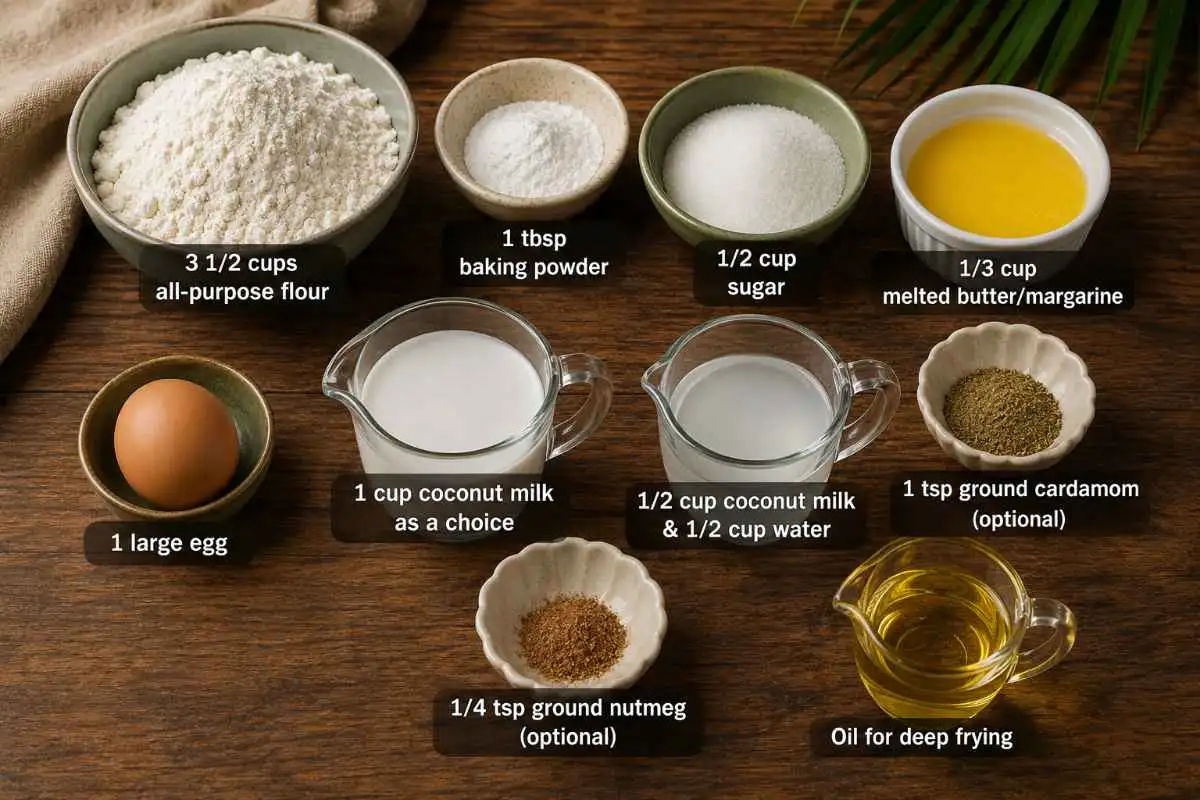
- 3 ½ cups all-purpose flour
- 1 tbsp baking powder
- ½ cup sugar
- ⅓ cup melted butter/margarine
- 1 large egg
- 1 cup coconut milk as a choice ½ cup coconut milk and ½ cup water
- 1 tsp ground cardamom (optional)
- ¼ tsp ground nutmeg (optional)
- Oil for deep frying
Instructions
- In a large mixing bowl, add the flour, baking powder, sugar, cardamom, and nutmeg (if using). Mix well.
- Add the egg and butter, followed by coconut milk. Mix to combine using a spatula.
- Utilizing your hands, knead the dough for about 5 minutes until it becomes smooth.
- Heat oil in a deep frying pan over medium heat.
- Meanwhile, on a lightly floured surface, roll out the dough to about an inch thick. Cut into the desired shape. You could cut them into squares or triangles, or use a cookie cutter of whatever shape you want. Be creative.
- Check if the oil is ready. It is ready when bubbles form around a wooden spoon. You could also cut a tiny piece of the dough and drop it to test its readiness.
- Drop the cut dough and lower the heat to avoid burning on the outside and uncooked inside. Flip the mandazis every 30 sec and cook for about 1.5-2 minutes.
- Fry the mandazi until golden brown and puffed up.
- Remove from the oil and place them on a paper-towel-lined bowl to drain excess oil.
- Serve and enjoy!

How to Make East African Mandazi
Ingredients
- 3 ½ cups all-purpose flour
- 1 tbsp baking powder
- ½ cup sugar
- ⅓ cup butter melted
- 1 large egg
- 1 cup coconut milk
- 1 tsp cardamom ground
- ¼ tsp nutmeg ground
- oil for deep frying
Instructions
- In a large mixing bowl, add the flour, baking powder, sugar, cardamom, and nutmeg (if using). Mix well.
- Add the egg, and butter, followed by the coconut milk. Mix to combine using a spatula.
- Using your hands, knead the dough for about 5 minutes until it becomes smooth.
- Heat oil in a deep frying pan over medium heat.
- Meanwhile, on a lightly floured surface, roll out the dough to about an inch thick. Cut into the desired shape. You could cut them into squares or triangles or use a cookie cutter of whatever shape you want. Be creative.
- Check if the oil is ready. It is ready when bubbles form around a wooden spoon. You could also cut a tiny piece of the dough and drop it to test if it's ready.
- Drop in the cut dough and lower the heat to avoid burning on the outside and uncooked inside. Flip the mandazis every 30 sec and cook for about 1.5-2 minutes.
- Fry the mandazi until golden brown and puffed up.
- Remove from the oil and place them on a paper-towel-lined bowl to drain excess oil.
- Serve and enjoy!
Video
Notes
Nutrition
Health Benefits of Key Ingredients
People sometimes think fried food and “healthy” can’t sit in the same sentence. But mandazi’s ingredient list actually has some genuinely good things going for it, especially when you look at the individual components.
Coconut Milk
Coconut milk adds richness and a naturally sweet, creamy flavor to the dough. It is high in saturated fat, so enjoy mandazi in moderation.
Cardamom
Cardamom is a warming, slightly floral spice that gives mandazi its signature aroma. It is widely used in traditional East African and South Asian cooking.
Eggs
Eggs add more richness and help in binding the dough.
All-purpose flour
All-purpose flour gives the dough its structure and soft crumb.
Like any fried food, mandazi is best enjoyed in moderation. The air fryer version below uses less oil. Two to three mandazi with a cup of chai is a satisfying, energizing meal that fits comfortably into a balanced diet.
Traditional vs Modern Mandazi Variations
One of the most interesting things happening in East African food culture right now is how the making of mandazi recipe traditions is evolving. Classic technique meets contemporary creativity, and the results are genuinely exciting.
Classic Coastal Mandazi The original coconut milk base, cardamom spice, light sugar, triangle or square shaped, fried in vegetable oil. This is what you find at a Mombasa market stall or a Dar es Salaam tea shop. Simple, perfect, unchanged for good reason.
Kenyan Upcountry Style Slightly less coconut, more water, sometimes spiced with cinnamon in addition to cardamom. Larger pieces are often round.
Tanzanian Maandazi Often a little sweeter and puffier. Some Tanzanian recipes include a small amount of vanilla extract. The dough is sometimes rested longer for a softer interior.
Modern Variations Making Rounds Online
- Chocolate Mandazi Cocoa powder added to the dough, often served with a salted caramel dip.
- Stuffed Mandazi Filled with spiced custard, Nutella, or savory fillings like spiced lentils.
- Glazed Mandazi Honey glaze or icing sugar finish for a dessert presentation.
- Air-Fried Mandazi Same dough, brushed with oil, cooked at 180°C for 10–12 minutes. Less oil, still a good puff.
- Baked Mandazi The least traditional but a lighter option for home kitchen, the texture is more biscuit-like, but the flavor holds up.
- Vegan Mandazi Egg replaced with a flax egg and the butter replaced with plant-based butter.
The recipe for making mandazi has always been flexible. What’s stayed constant across every version is the dough’s forgiving nature, it’s hard to mess up if you follow the temperature and timing basics.
How to Make Mandazi in an Air Fryer
For those cooking with less oil, the air fryer has become a practical alternative that actually works with mandazi, better than most people expect.
What you need to know
Air frying won’t give you the same deep-golden crust as traditional frying, and the puff is slightly less dramatic. But the interior texture is surprisingly close, and the cleanup is significantly easier.
Air Fryer Mandazi Method:
- Prepare the dough exactly as the original recipe describes, no changes needed.
- Cut the dough into your preferred shapes.
- Lightly brush or spray each piece with neutral oil (avocado or vegetable oil works well).
- Preheat the air fryer to 180°C (360°F) for 3 minutes.
- Place mandazi in a single layer without overcrowding. This is crucial, because crowding causes steaming instead of crisping.
- Air fry for 10–12 minutes, flipping halfway through at the 5-minute mark.
- Remove when golden and puffed. Rest for 2 minutes before serving.
The result is lighter, slightly less rich, but genuinely satisfying. If you’re serving these alongside a heavier dish like our Garlic Butter Steak Bites or a rich soup, the air-fried version balances the meal nicely.
What to Serve with Mandazi
This is where mandazi really shines, its versatility. Depending on the time of day and what you’re going for, the pairing options are genuinely broad.
For Breakfast
The most traditional pairing is masala chai, black tea brewed strongly with spices. The bitterness of the tea against the sweetness of mandazi is one of those flavor combinations that just works. If you’re already making a big breakfast spread, mandazi pairs perfectly with our Pancake Breakfast spread for a fusion brunch that surprises guests in the best way.
For a Snack
Mandazi with a drizzle of honey or a sprinkle of cinnamon sugar. Some families serve them with a side of jam. Others prefer them plain, the cardamom and coconut carry the flavor on their own.
As Part of a Larger Meal
In coastal East Africa, mandazi is sometimes served alongside savory dishes, acting as bread would in other cuisines. Pair it with a bean soup or a light vegetable stew.
For Dessert
Glazed or dusted with powdered sugar, mandazi becomes a dessert. Try serving them warm next to a scoop of vanilla ice cream.
For Something Tropical
Round out the flavor profile with a cold glass of our Easy Tropical Smoothie, the mango and pineapple notes play beautifully against the cardamom in the mandazi.
Pro Tips for the Best Results
These aren’t generic tips you’ve read on every food site. These come from actually making mandazi repeatedly and figuring out what the recipe doesn’t tell you.
Knead until smooth. Knead the dough for about 5 minutes until it is smooth. Properly kneaded dough is easier to roll and cut, and puffs evenly in the oil.
Your oil temperature is everything. The single biggest reason mandazi comes out wrong is oil that’s too hot or too cold. Invest 60 seconds in testing the oil with a small piece of dough before you start frying the whole batch. It makes a real difference.
Keep the thickness even. Roll the dough to about an inch thick and cut the pieces the same size so they cook at the same rate. Pieces rolled too thin puff less and turn cracker-like.
Fry in small batches. Dropping too many pieces into the oil at once drops the oil temperature. This leads to uneven cooking and oily mandazi. Four to five pieces at a time is the sweet spot for most home pans.
Add a pinch of salt if you like. Salt is not in the recipe, but a small pinch (about ¼ tsp) mixed in with the dry ingredients sharpens the other flavors. This is optional.
Use the cardamom for the most authentic flavor. It is optional in this recipe, but if you want mandazi that tastes like it came from a Kenyan kitchen, don’t leave it out.
Common Mandazi Problems
Mandazi are dense and didn’t puff up at all. Almost always one of two issues, either the baking powder is old (check the expiry date; it loses potency over time) or the oil wasn’t hot enough when the dough went in. The oil needs to be at the right temperature to trigger an immediate steam reaction in the dough, which causes the puff.
Golden outside, raw inside. The oil is too hot. The exterior is cooking and sealing before the heat reaches the center. Lower the heat and fry longer.
Very oily mandazi. The oil was too cool when the dough went in. Cool oil doesn’t seal the exterior quickly enough, so the dough absorbs it like a sponge. Always test the oil temperature before starting.
Mandazi turned out too hard. Either the dough was over-kneaded (which develops too much gluten) or too much flour was added during rolling. Use a light hand with the surface flour.
All the pieces are different colors. This is usually a pan-size issue, the pieces near the edge of the pan are at a different temperature than those in the center. Stir the oil gently before each batch and keep the heat steady once you have lowered it.
Make Ahead and Storage Guide
One of the underrated strengths of this African donut mandazi recipe is how well it works for batch cooking and advanced preparation.
Making the dough ahead
You can mix and knead the dough up to 12 hours in advance. Wrap it tightly in cling film and refrigerate. When ready to fry, take the dough out 20–30 minutes before to bring it back to room temperature, cold dough is harder to roll and may not puff as well.
Storing cooked mandazi
Let them cool completely before storing. Room temperature in an airtight container: 1–2 days. Refrigerator in a sealed bag: up to 4 days. Frozen: up to 3 months.
Reheating
The oven is the best method, 160°C for 5–7 minutes brings them back close to their original texture. The microwave works for speed but softens the exterior. The air fryer at 160°C for 3–4 minutes is probably the best balance of speed and texture quality.
For events and gatherings
This recipe makes 32 pieces as written. It doubles cleanly, just ensure your mixing bowl is large enough, and fry in multiple batches. For a party of 20–25 people where mandazi is one of several items, a double batch is typically enough.
Mandazi African Donuts Recipe: Regional Variations Worth Knowing
The beauty of this dish across East Africa is that every community has put its own fingerprint on the mandazi African donut recipe. Here’s a quick guide to what sets each regional style apart:
Zanzibar Mandazi
The island’s version often uses more coconut milk than other styles, sometimes with no water at all. The result is richer and more yellow. Often shaped into thin triangles and fried to a crispier texture than mainland versions.
Ugandan Amandazi
Frequently incorporates maize (corn) flour alongside wheat flour for a slightly denser texture and a more golden hue. Sometimes made with fermented milk, which adds a very mild tang.
Rwandan Mandazi
Simpler spicing, often just cardamom or nothing at all. The focus is on the dough texture rather than the flavor additions. Served most commonly at breakfast.
Coastal Kenya Mandazi
The standard-bearer that most diaspora and international recipes are based on. Coconut milk, cardamom, medium sugar, triangle or square shaped. This is the version our recipe is built on.
Somali Cambaabur
A close cousin of mandazi, thinner, more crepe-like, and made with yeast rather than baking powder. Worth mentioning because many people discover mandazi through searching for similar East African fried breads.
Mahamri
A related Swahili Coast fried bread, usually made with yeast, so it needs time to rise and Mahamri Fluffy Kenyan Donuts are often flavored with coconut milk and cardamom.
Serving Occasions and Cultural Context
Mandazi isn’t tied to one meal or one moment in East African life, it crosses every occasion with ease.
At breakfast, it’s the chai companion. At school, it’s the packed snack. At community events, it’s fried in enormous batches by vendors. During Ramadan, it appears at iftar tables across Kenya and Tanzania, often alongside dates and warm drinks as a way to break the fast gently. At weddings and celebrations, it’s part of the spread that signals abundance and care.
In Kenyan markets, mandazi vendors are some of the earliest risers, starting their fires at 4 or 5 in the morning to have fresh batches ready by the time commuters and schoolchildren come through. The smell of frying mandazi on a cool morning is genuinely one of the defining sensory experiences of daily life in Nairobi and Mombasa.
That cultural weight is worth honoring when you make this at home. You’re not just following a recipe, you’re participating in a centuries-old food tradition that has fed families, marked celebrations, and started countless mornings across an entire continent.
Final Thoughts
There’s a reason why how to make mandazi keeps showing up in search results year after year. It’s not a trend. It’s not a moment. It’s one of those recipes that, once you’ve tasted it, becomes part of your kitchen rotation permanently. The version you’ve just read goes beyond a basic how-to. It gives you the history, the science, the problems, the variations, and the cultural context to make mandazi not just successful, but meaningful.
Whether you’re making a quick batch for a weekday breakfast, exploring new breakfast ideas, or preparing a large spread for a celebration, this recipe scales, stores, and satisfies every time. Try the classic version first. Then experiment with the air fryer method. Then try stuffing them. The dough is forgiving enough to withstand creativity, and the result is always worth it.
Also, try our other delicious recipes:
Frequently Asked Questions (FAQs)
What is mandazi?
Mandazi is a lightly sweetened, spiced fried dough from East Africa, popular in Kenya, Tanzania, and Uganda. It is similar to a doughnut but less sweet and more aromatic and it is part of everyday East African food culture.
How do you make mandazi without yeast?
This recipe utilizes baking powder rather of yeast, so there is no rising time. Mix the dough, knead for about 5 minutes, roll, cut and fry. The whole recipe takes about 35 minutes.
Can I bake mandazi instead of frying?
Yes, but the texture will be more biscuit like and the crust paler than fried mandazi. Bake at 180°C (356°F) until golden and brush with melted butter while warm. Baking times vary, so check them early.
Can I make mandazi without eggs?
Yes. Replace the egg with one flax egg. The texture will be slightly less rich. For a fully vegan version also swap the butter for plant based butter.
Can I use water instead of coconut milk?
You can use ½ cup coconut milk and ½ cup water, as noted in the ingredients. The mandazi will be a little less rich.
Is cardamom necessary?
No, it’s optional, but it gives mandazi its signature aroma. Use it if you can.
How do I store leftover mandazi?
Cool them completely first. Keep in an airtight container at room temperature for 1–2 days, in fridge for up to 4 days, or in the freezer for up to 3 months. Reheat in oven at 160°C for 5–7 minutes.
What is the difference between mandazi and beignets?
Mandazi is a kneaded dough flavored with cardamom and often coconut milk. New Orleans-style beignets use a soft, yeast-raised dough and are dusted with powdered sugar, while French-style beignets can be made with choux pastry. Mandazi is less sweet and more aromatic.
What is the difference between mandazi and mahamri?
Both are fried breads from the Swahili Coast. Mahamri is usually made with yeast, so it needs time to rise, while this mandazi uses baking powder and is ready to fry right away.
Why does my mandazi dough keep springing back when I roll it?
Dough that springs back is usually over-kneaded. Knead only until smooth (about 5 minutes). If it still springs back, let it sit for a minute or two and roll again.
Is mandazi healthy?
Mandazi is a fried treat, so it’s best enjoyed in moderation. At about 95 calories per piece (an estimate), a couple with tea makes a satisfying snack. The air fryer version uses less oil.













13 Comments. Leave new
Definitely trying this
Let me know how it turns out 🙂
Yummy
I’ll try making this
Delicious
Thank you! Glad you enjoyed it!
Looks good
It is! Give it a try!
Good with hot chocolate
100%
Hi, i read your blog from time to time and i own a similar one and i was just wondering if you get a lot of spam comments?
If so how do you protect against it, any plugin or anything you can suggest?
I get so much lately it’s driving me mad so any support is very much appreciated.
Hi Filomena, thanks so much for stopping by every now and then! Yes, I actually deal with the same issue! 😩 I’ve been marking the spam comments as spam as they come in and don’t approve, but I’m still trying to figure out the best way to prevent or reduce them altogether.
If I find a solution that works, I’ll definitely let you know! 😊 Also, what’s your blog? I’d love to check it out.
Keep this going please, great job!