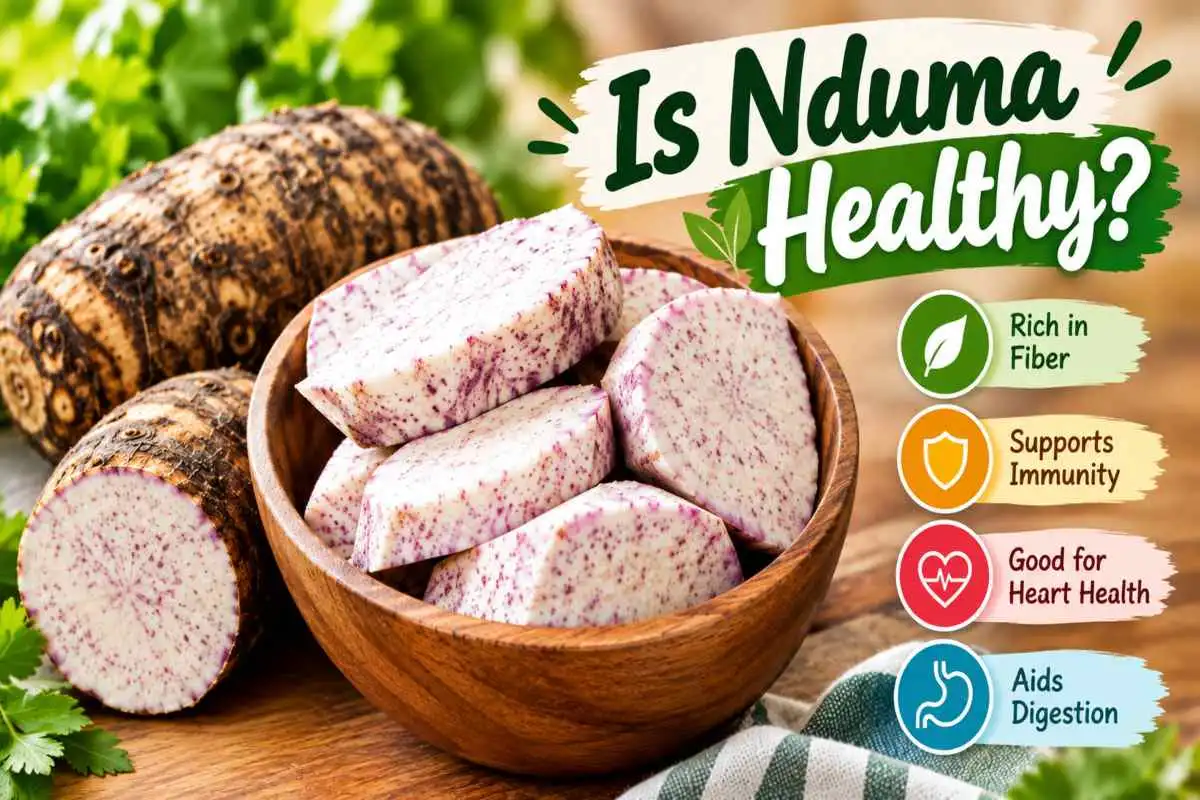
Is nduma healthy? Yes, nduma is healthy when boiled, steamed or lightly cooked. It is a fibre-rich, low-fat root that provides potassium and keeps you full longer. Deep frying adds fat and calories and you should never eat it raw because of calcium oxalate. People with diabetes or kidney problems should watch portions and check with a doctor.
Walk through any Kenyan market and you will find nduma stacked beside sweet potatoes and cassava, once dismissed as cheap filler and now a breakfast many people choose on purpose. Fiber plays a big role. USDA FoodData Central lists about 4 grams of fibre in 100 grams of raw taro root, which helps explain why a modest serving holds off hunger much longer than a slice of white bread.
A quick note on the name, because it explains why advice online can feel contradictory. In Kenya, nduma is the Kikuyu word for arrowroots, but the varieties grown here are taro-type roots, not the plant that arrowroot powder comes from. This guide sticks to the nduma you actually buy and boil. It covers the nutrition, who benefits most, the real side effects and how boiling compares with frying. Once you know what you are eating, try this Creamy Coconut Nduma for a richer way to cook it.
What Is Nduma? (Meaning in English)
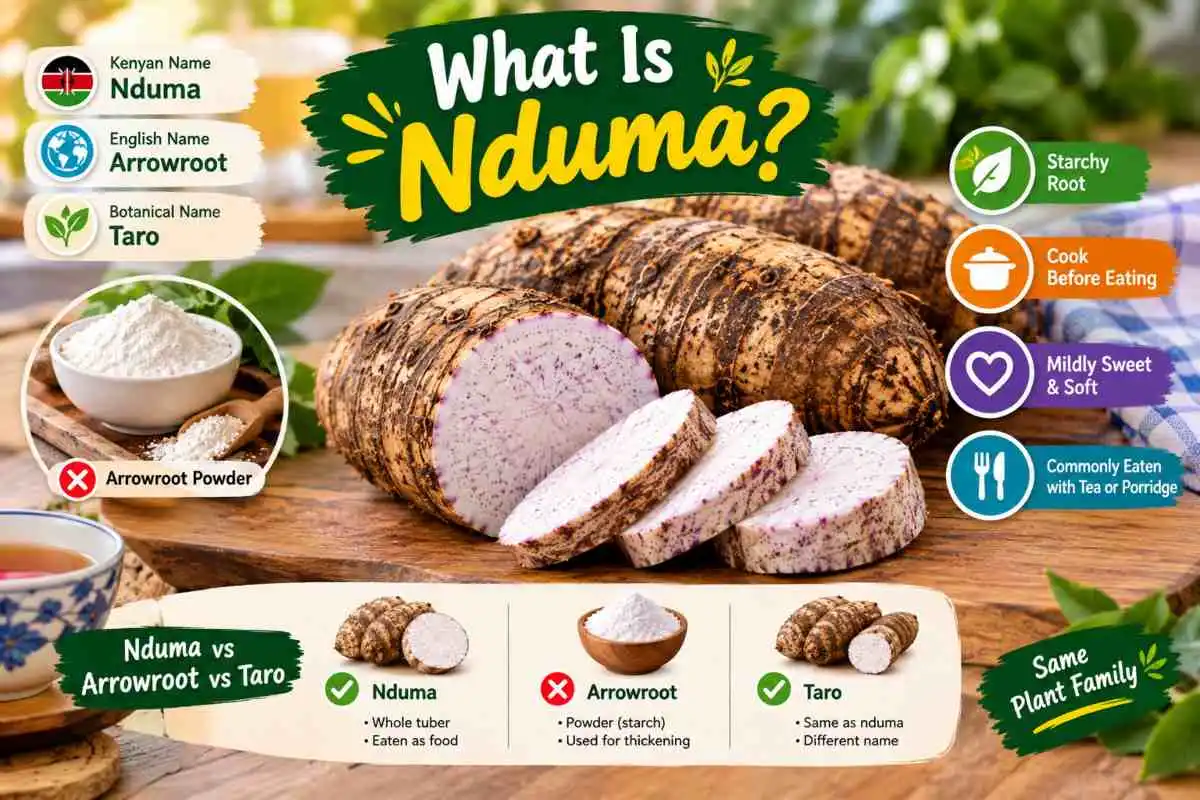
Nduma is the Kenyan name for a starchy underground root that is boiled, fried or stewed, usually sold in English as “arrowroots.” Botanically, it is taro, a different plant from the one that gives arrowroot powder. It has brown, ringed skin and pale flesh often flecked with purple and it becomes soft and mildly sweet when cooked. Kenyans most often eat it boiled at breakfast, with tea or porridge.
Nduma meaning in English and Kenyan names
In English, nduma is usually translated as arrowroot and in Kenya the word “arrowroots” is how most people refer to it in shops and on menus. The name itself comes from Kikuyu and has since spread across the country, so you will hear it in Nairobi markets and Swahili conversation alike. Outside Kenya the same root goes by several names. Taro is the most widely used and cocoyam is common in West Africa.
According to Standard Media’s farming coverage, Kenyans often describe the types as dasheen, which has large tubers and eddoe, a smaller kind that tolerates drier ground. If a recipe or article calls the root taro, dasheen or cocoyam, it describes the same plant family you know as nduma.
Is nduma the same as taro root?
Yes, in practice. The nduma sold in Kenyan markets is taro (Colocasia esculenta), even though people call it arrowroot. The confusion is a labeling habit rather than a botanical fact, which is why English-language advice about “arrowroot” can seem to describe a different food. Taro shares one important safety rule with nduma, it contains calcium oxalate, which can irritate the mouth and throat, so it should always be cooked thoroughly and never eaten raw. Boiling or baking until fully soft is the normal, safe way to prepare it.
Nduma vs arrowroot vs taro a clear comparison
These three names overlap in a way that trips up many readers. Nduma is the Kenyan name, taro is the botanical and international name for the same root and arrowroot is the English label Kenyans use for it, even though true arrowroot is a separate plant (Maranta arundinacea).
The plants differ in what you actually eat. Nduma is a whole starchy tuber, boiled and eaten as a staple. True arrowroot is mostly processed into a fine white starch and is rarely eaten as a fresh root. So when a source praises “arrowroot” for something, check whether it means the tuber or the powder before applying the advice to your breakfast nduma.
Arrowroot powder vs nduma
Arrowroot powder is a refined starch, while nduma is a whole food. The powder is extracted from the rhizomes of the true arrowroot plant, then dried and ground into a smooth, flavorless white flour. Cooks use it to thicken sauces and fruit fillings and to make gluten-free baking mixes.
It is not what you buy when you ask a Kenyan vendor for nduma and it does not behave the same way nutritionally, because processing removes most of the fibre a whole root provides. For the question this guide answers, only the cooked root matters. Treat advice about arrowroot powder as a separate topic.
Nduma Nutrition Facts
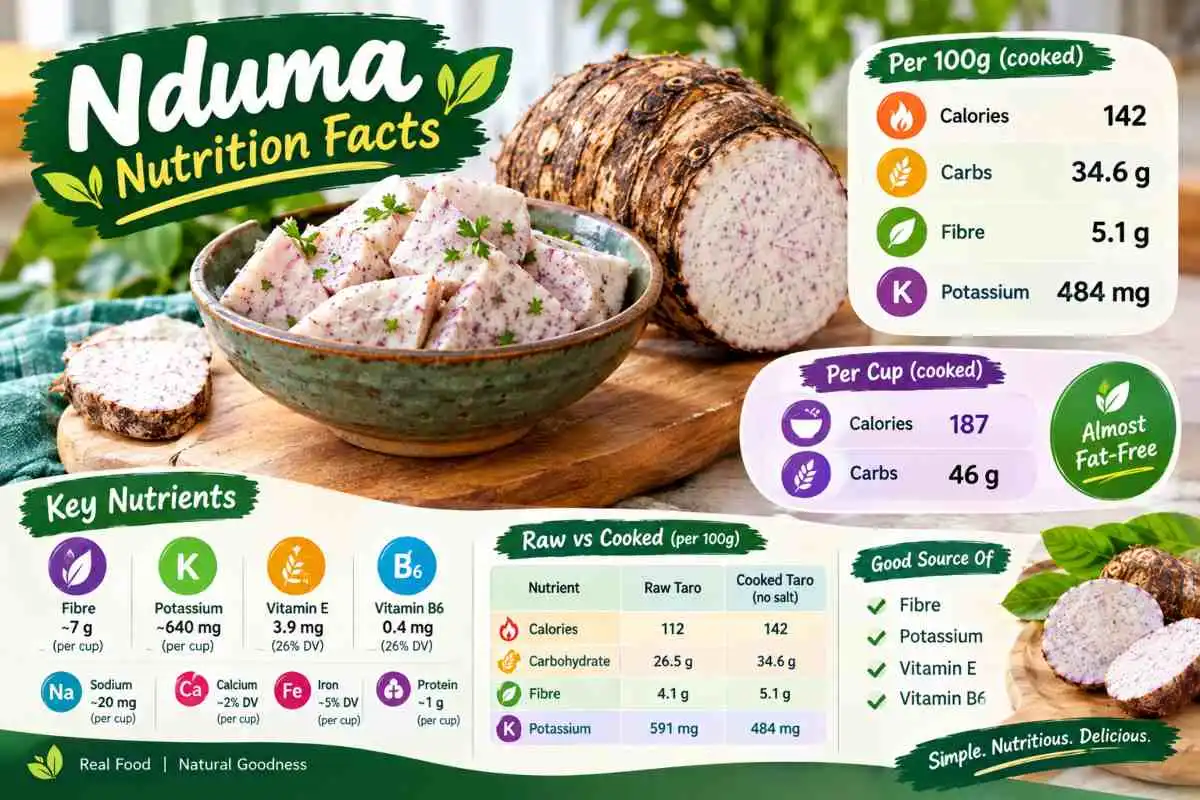
Cooked nduma is a starchy, high-fibre, almost fat-free root. USDA doesn’t list “nduma” by that name, but its entries for taro, the root Kenyans call nduma, show 142 calories per 100 grams for cooked taro without salt. The same entry gives about 5.1 g of fibre, 34.6 g of carbohydrate and 484 mg of potassium. Treat these figures as a close guide, not a lab analysis of the specific root in your kitchen.
Nduma calories and carbs per serving
A cup of cooked nduma is about 187 calories and 46 grams of carbohydrate. USDA’s label data for a cup of sliced cooked taro (132 g) shows 187 calories, 46 g of carbohydrate, 7 g of fibre and virtually no fat. Per 100 grams, that is the 142 calories above. Subtracting fiber leaves roughly 29.5 g of net carbs per 100 grams, so nduma is a carbohydrate food closer to a potato than a leafy vegetable. These numbers assume plain boiling. Oil from frying adds calories on top, which the boiled vs fried section covers.
Fibre, potassium and other key nutrients
Nduma strongest nutritional points are fiber and potassium. A cup of cooked taro supplies about 640 mg of potassium, roughly 7 g of fiber, 3.9 mg of vitamin E (26% DV) and 0.4 mg of vitamin B6 (26% DV). Sodium is very low, around 20 mg per cup when cooked without salt. Protein is modest, about 1 gram per cup, so nduma works best alongside an egg, milk or beans rather than as a protein source. Calcium and iron are present in small amounts, around 2% and 5% of the Daily Value per cup.
Boiled vs raw values
USDA lists raw and cooked taro as separate entries. Per 100 grams:
| Raw taro | Cooked taro (no salt) | |
|---|---|---|
| Calories | 112 | 142 |
| Carbohydrate | 26.5 g | 34.6 g |
| Fibre | 4.1 g | 5.1 g |
| Potassium | 591 mg | 484 mg |
The raw figures come from USDA’s raw taro entry, 112 calories, 26.5 g of carbohydrate, 4.1 g of fibre and 591 mg of potassium per 100 grams. The higher calories and fibre in the cooked row shouldn’t be read as cooking adding energy. The two entries are measured separately and differ in water content, so only compare them loosely.
The lower potassium in the cooked row likely reflects some minerals leaching into the cooking water, so keeping the water for soups or stews, where appropriate, retains more of it. The raw values are for reference only, since nduma must be cooked before eating. You can check both entries on USDA FoodData Central, raw taro and cooked taro.
Health Benefits of Nduma
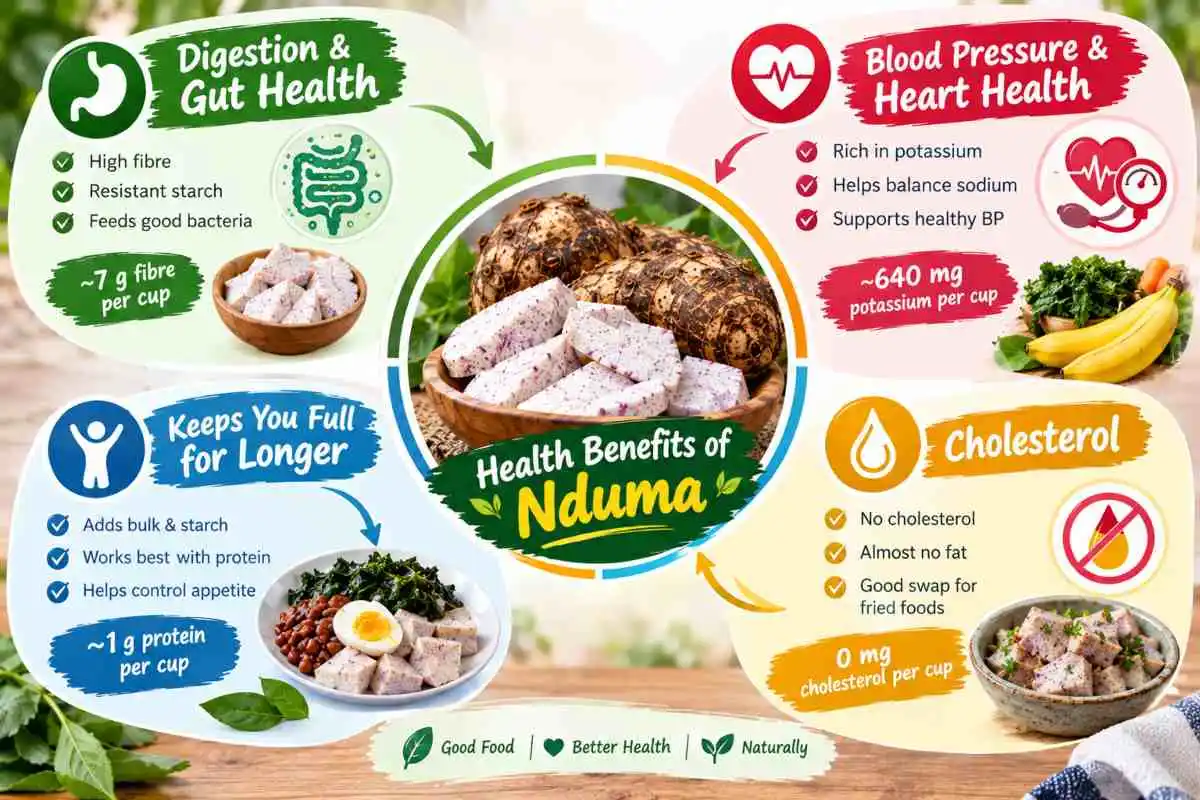
Nduma’s health benefits come mainly from its fibre, resistant starch and potassium, which support digestion, blood pressure and fullness. Most direct research is on taro in the lab or in animals, so these are plausible food-based benefits, not treatments.
Digestion and gut health
Nduma supports digestion through fibre and resistant starch, which reach the large intestine and feed gut bacteria. A cup of cooked taro provides about 7 g of fibre. In a lab digestion and fermentation test on five taro varieties, higher resistant starch went with more butyric acid, a short-chain fatty acid linked to gut health. In diabetic rats, both taro flour and taro starch raised faecal levels of acetate, propionate and butyrate. These studies were not done in people, so read them as encouraging rather than proven. If your usual diet is low in fibre, add nduma gradually so your gut can adjust.
Blood pressure and heart health
Nduma supports heart health mainly through potassium, a mineral that counteracts sodium’s blood-pressure effect. A cup of cooked taro supplies around 640 mg of potassium, about 14% of the Daily Value. Too little potassium in the diet can raise blood pressure.
A meta-analysis of 19 trials found potassium supplements lowered systolic pressure by about 5.9 mmHg and diastolic by 3.4 mmHg, with larger drops in people who already had high blood pressure. That evidence is about potassium in general, not nduma specifically, so nduma is best seen as one helpful source among many. Boil it with little salt to keep the benefit. People with kidney disease or on diuretics should ask a doctor about potassium intake.
Cholesterol
Nduma contains no cholesterol and almost no fat, making it a sensible swap for fried or fatty starches, but there is no good evidence that it lowers cholesterol. A cup of cooked taro has 0 mg of cholesterol and virtually no fat. The fibre that reliably lowers LDL cholesterol is the soluble, viscous kind found in oats, barley and beans. A review found such fibres cut total and LDL cholesterol by about 5–10%. Nduma’s fibre hasn’t been shown to do the same, so pair it with beans or vegetables if cholesterol is a concern.
Keeping you full for longer
Nduma is a filling food, but fibre alone doesn’t guarantee lasting fullness. A systematic review of 44 publications found only 39% of fibre treatments reduced appetite ratings compared with a control. In practice, nduma’s bulk and starch help and it works best with protein. One Nairobi commuter says a breakfast of porridge, nduma, sweet potato and a boiled egg keeps them going until late afternoon. Nduma itself is low in protein, about 1 g per cup, so adding an egg, milk or beans is what turns it into a lasting meal.
Is Nduma Good for Weight Loss Or Fattening?
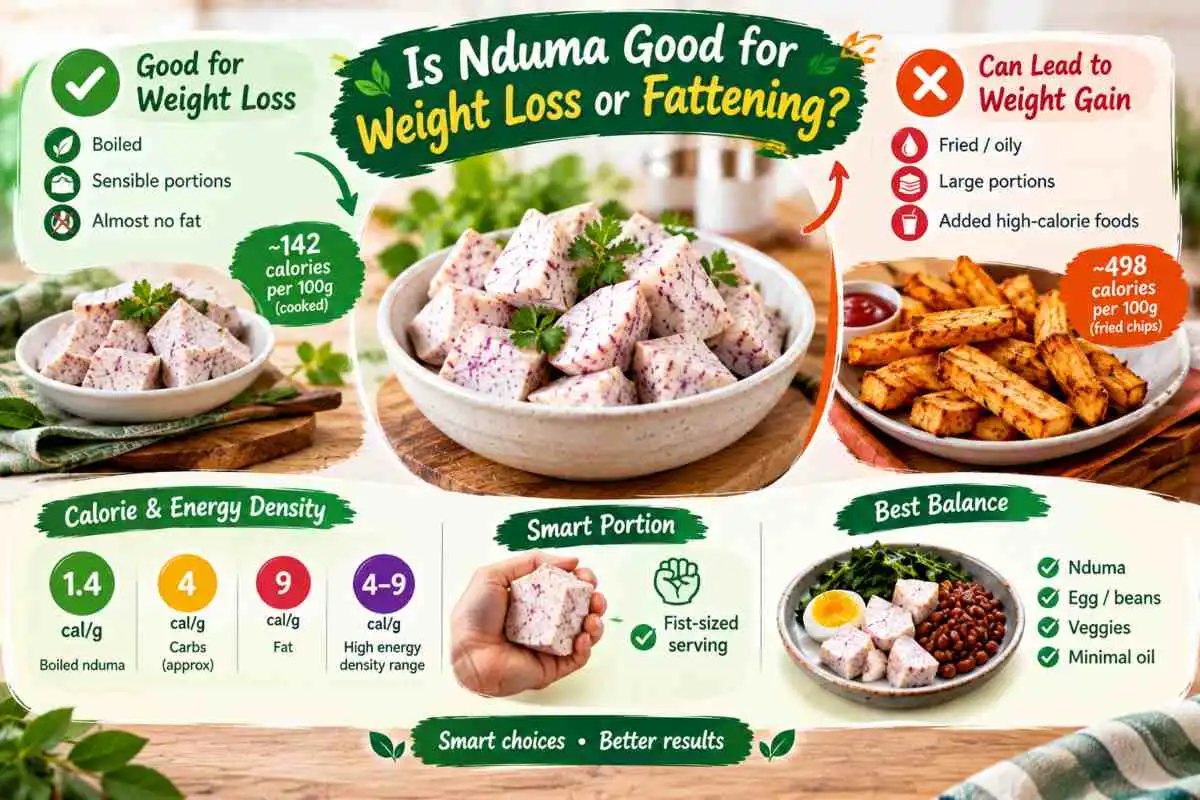
Nduma can fit into a weight-loss diet when it is boiled and eaten in sensible portions and it isn’t fattening on its own. What decides its effect on your weight is how it is cooked and how much you eat. No trials have tested nduma itself for weight loss, so this advice rests on its nutrition profile and general research on calorie density.
Portion size and preparation matter
Boiled nduma is relatively light for its bulk, while fried nduma is not. USDA data lists cooked taro at 142 calories per 100 grams and a cup of sliced cooked taro at about 187 calories with virtually no fat. USDA entry for packaged taro chips shows 498 calories and 24.9 g of fat per 100 grams, more than three times as many calories by weight. Fat carries about 9 calories per gram against roughly 4 for carbohydrate, so frying changes the numbers quickly.
At about 1.4 calories per gram, boiled nduma sits well below the 4 to 9 calories per gram range that counts as high energy density, while the chips fall inside it. Lower energy density lets you eat a satisfying portion for fewer calories and a clinical trial found that advice to choose low-energy-dense foods worked better for weight loss than cutting fat and restricting portions. Portion size still matters, because larger portions lead to eating more. A fist-sized serving of boiled nduma is a reasonable starting point, but adjust it to your own calorie needs.
Does nduma make you gain weight?
Nduma does not make you gain weight by itself. Weight gain comes from regularly eating more calories than your body uses and nduma only contributes to that if the portions are large or it’s fried or cooked in a lot of oil. It is almost entirely carbohydrate, with very little protein or fat, so it is easy to eat a lot of it without feeling you have had a full meal.
The most common way nduma can add to weight is as an extra on top of your usual breakfast rather than a replacement for it. If you eat nduma plus bread plus a sweetened drink, the calories stack up. If it replaces a fried item like mandazi, the calories usually drop. Pairing a modest portion with an egg or beans and keeping oil to a minimum, is the simplest way to keep it working in your favour.
Is Nduma Good for Diabetics?
People with diabetes can usually eat nduma in controlled portions, but it is a starchy food, not a free pass. Boiled nduma has a moderate glycemic index in the one measurement I found, so how much you eat and what you eat it with matter more than the food itself. Individual blood sugar responses vary, so personal advice from your care team comes first.
Nduma glycemic index (is it low GI?)
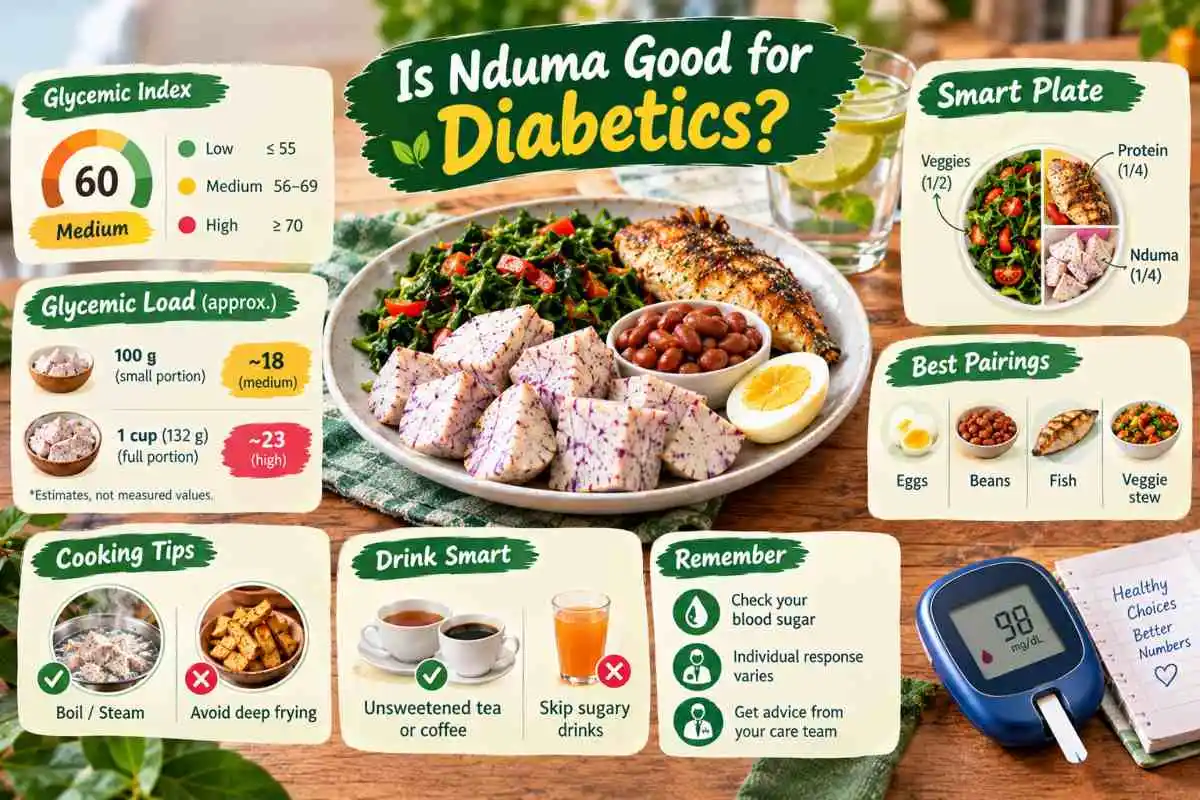
Nduma is not clearly a low-GI food. Nduma is taro and a glycemic index study using the standard ISO method measured taro at 60, which falls in the medium range. The same paper notes taro’s fibre suggests it could be lower, but says its GI had not been properly established before, so it is thin evidence. On the usual scale, 55 or less is low, (56 to 69) medium and 70 or more is high, so nduma sits near the top of the medium band.
Glycemic load adds portion size by multiplying carbohydrate grams by GI and dividing by 100, with 10 or less considered low and 20 or more high. Using 29.5 g of net carbs per 100 grams of cooked taro, 100 grams (a small serving) works out to a glycemic load of about 18, which is medium. A full cup of 132 grams comes to about 23, which is high. These are my rough estimates, not measured values, but they show how quickly the portion decides the effect. Research is also mixed on whether choosing foods by GI improves long-term blood sugar control, so use GI as a rough guide, not a rule.
Portion and pairing tips
The simplest way to eat nduma with diabetes is to treat it as the carbohydrate on your plate, not the whole meal. The American Diabetes Association’s plate method fills half a 9-inch plate with non-starchy vegetables, a quarter with lean protein and a quarter with carbohydrate foods. Starchy roots like potatoes and sweet potatoes belong in that carbohydrate quarter and nduma fits there too.
Fibre and protein slow digestion, which helps keep blood sugar steadier, so pairing a modest portion of boiled nduma with an egg, beans, fish or a vegetable stew works better than eating it alone. Boiling or steaming is the safer preparation, since deep frying adds fat and calories without lowering the carbohydrate load.
If you usually have it with tea, switch to unsweetened tea or coffee to avoid adding sugar on top of the starch. Test your own response by checking your glucose after a meal with nduma, since your reading is the best evidence for your own body.
Nduma vs Other Staples
Boiled nduma beats white bread, cassava and potatoes on fibre and glycemic index, but it is not lighter than them on calories. Sweet potato is the one staple that has fewer calories and carbs per 100 grams, though nduma has more fibre and a lower GI. The table below uses USDA nutrition data and published GI values for each food boiled or cooked, per 100 grams.
| Per 100 g, cooked | Calories | Carbs | Fibre | GI (glucose = 100) |
|---|---|---|---|---|
| Nduma (taro) | 142 | 34.6 g | 5.1 g | 53 ± 2 |
| White bread | 270 | 49.2 g | 2.3 g | 75 ± 2 |
| Sweet potato (ngwaci) | 76 | 17.7 g | 2.5 g | 63 ± 6 |
| Cassava | 161 | 38.3 g | 1.8 g | 74 (Western Kenya study) |
| Potato (boiled, no skin) | 86 | 20.0 g | 1.8 g | 78 ± 4 |
Nduma vs bread for breakfast
Nduma is the better breakfast carbohydrate for fibre and blood sugar, but not for calories. Per 100 grams, bread has almost twice the calories (270 vs 142), but bread is eaten by the slice. Two USDA-sized slices (about 55 g) come to roughly 148 calories and 1.3 g of fibre.
A 100 g portion of nduma has about the same calories with around 5.1 g of fibre, nearly four times as much (my arithmetic from the table). The GI gap is also clear, with boiled taro at 53 against 75 for white wheat bread. Whole wheat bread scores 74, so switching to brown bread does not close that gap. Nduma has little protein, so pair it with an egg or milk to match a bread-based breakfast.
Nduma vs ngwaci (sweet potato)
Ngwaci has fewer calories and carbs per 100 grams, while nduma has more fibre, more potassium and a lower GI. Cooked sweet potato has 76 calories and 17.7 g of carbs against nduma’s 142 and 34.6 g, though part of that gap is nduma’s lower water content.
Nduma has about twice the fibre and 484 mg of potassium per 100 grams against 230 mg for sweet potato. Ngwaci’s GI is 63 in the international tables and a Western Kenya study found 65. Ngwaci wins on vitamin A, with 787 mcg per 100 grams (retinol activity equivalents) compared with about 4 mcg for nduma. Rotating the two gives you the benefits of both.
Nduma vs cassava
Nduma beats cassava on fibre and GI. Cooked cassava has 161 calories and 38.3 g of carbs per 100 grams against nduma’s 142 and 34.6 g, but only 1.8 g of fibre compared with 5.1 g. A Western Kenya study measured boiled cassava at a GI of 74, high on the standard scale, while boiled taro is 53. Both need proper cooking. Bitter cassava can contain toxic cyanogenic compounds and nduma contains calcium oxalate, so neither should be eaten undercooked.
Nduma vs potatoes
Nduma has more fibre and a lower GI than boiled potato, but potato has fewer calories per 100 grams. Boiled potato has 86 calories, 20 g of carbs and 1.8 g of fibre, while nduma has 142 calories, 34.6 g and 5.1 g. Boiled potato’s GI is 78, in the high range, against 53 for nduma. Nduma also has more potassium (484 mg vs 328 mg per 100 g). Potato’s GI varies by variety and lower-GI cultivars exist, so the potato figure is an average rather than a fixed value. If your goal is the fewest calories per plate, potato or sweet potato wins. If it is fibre and steadier blood sugar, nduma wins.
Is Fried Nduma Healthy? Boiled vs Fried vs Air-Fried
Fried nduma is less healthy than boiled nduma, but it isn’t off-limits. Frying adds fat and calories and browning starchy foods at high heat creates acrylamide, a chemical that boiling and steaming typically don’t produce. Air-frying or lightly pan-browning with a little oil is a reasonable middle ground and deep-fried nduma is best kept as an occasional treat.
Are nduma chips healthy?
Nduma chips are a snack food, not a health food. USDA’s entry for taro chips lists 498 calories and 24.9 g of fat per 100 grams, while boiled taro has 142 calories and almost no fat. A 1-ounce serving of chips is about 141 calories and branded chips in the USDA database are around 500 to 536 calories per 100 grams.
Deep-fried foods typically absorb roughly 8% to 25% of the oil they are cooked in, which adds the extra calories. Thin, crisp chips are also a concern for acrylamide, because the UK’s Food Standards Agency says foods like crisps appear to have among the highest levels. The chips still keep some of nduma’s fibre, with USDA listing about 7 g per 100 grams. Eating a small handful now and then is fine. Making them daily replaces a high-fibre staple with a calorie-dense snack.
Healthiest ways to cook nduma (boiled, stove-top or air fryer)
Boiling is the healthiest and safest way to cook nduma. FDA guidance says boiling and steaming typically don’t form acrylamide and it recommends choosing boiling or steaming over frying or roasting. Boiling also deals with taro’s calcium oxalate. Toxicology guidance says taro root should be thoroughly cooked in boiling water so oxalates leach into the water, which should then be discarded. Boiling before browning also fits the traditional Kenyan approach of boiling nduma first, then frying it.
For a stove-top version, boil the nduma until tender, then brown the pieces briefly in a non-stick pan with about a teaspoon of oil. For an air fryer, boil first, then air-fry with a teaspoon of oil until golden. An air fryer needs only about a tablespoon of oil, far less than deep frying. One study found air-frying cut acrylamide by up to 90% compared with deep frying, though another found slightly higher levels in air-fried potatoes than in deep-fried or oven-baked ones, so the evidence is mixed. In both cases, aim for golden yellow rather than dark brown, as the FDA recommends to reduce acrylamide when frying or roasting starchy foods.
Can You Eat Nduma Raw? Safety and Side Effects
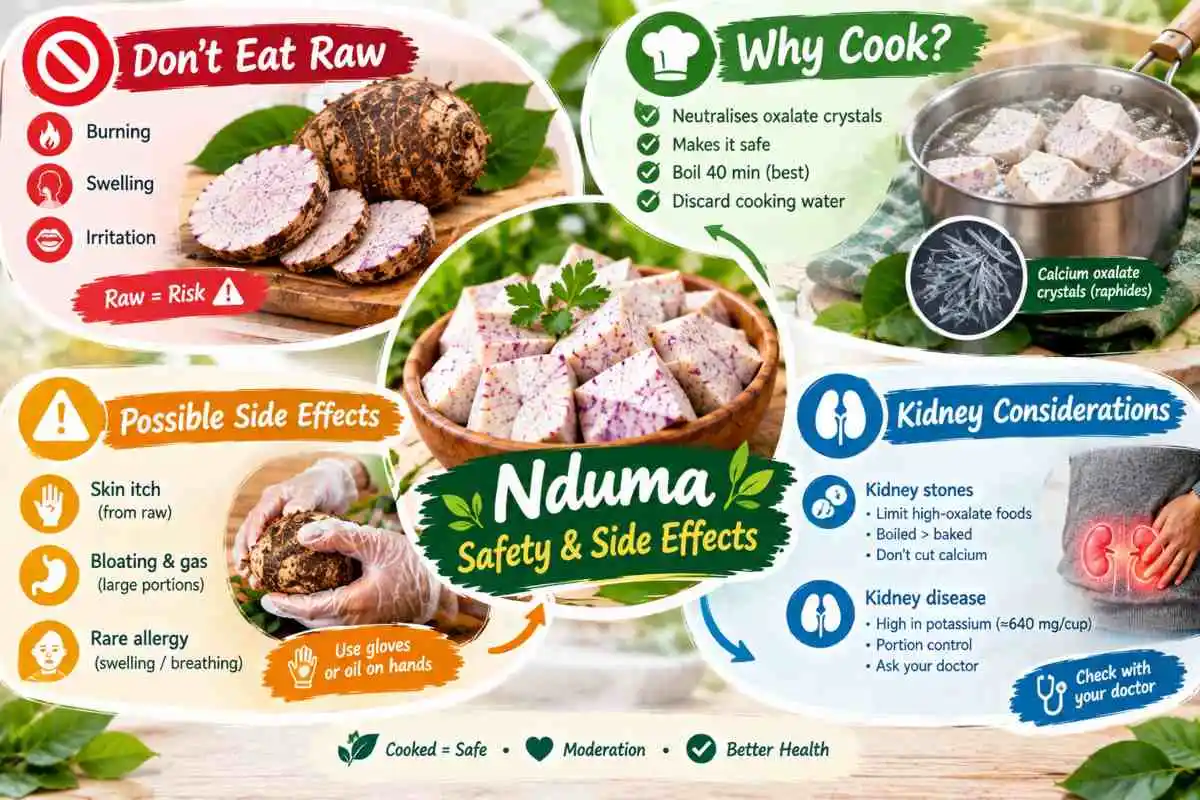
No, you should never eat nduma raw. Raw nduma contains sharp calcium oxalate crystals that can cause burning, swelling and irritation of the mouth and throat. Thorough cooking makes it safe for most people. A few groups, especially people with kidney stones or kidney disease, should check with a doctor first.
Calcium oxalate and why nduma must be cooked
Raw nduma contains needle-shaped calcium oxalate crystals called raphides and cooking is what neutralises them. Chewing releases the crystals, which pierce the lining of the mouth and throat. Toxicology guidance warns that uncooked taro root can cause mouth irritation and swelling and in serious cases swelling that obstructs the airway. Boiling is the traditional fix.
In a study of Japanese taro, about 61% of the oxalate in raw tissue was the soluble kind and boiling for 40 minutes brought it below detectable levels as it leached into the cooking water. Baking did not do the same, because it concentrated the remaining oxalate. Toxicology guidance also says to thoroughly boil taro and throw away the cooking water. Cook nduma until the centre is completely soft and never taste a raw piece. If your lips, tongue or throat swell or you have trouble breathing after eating undercooked nduma, seek urgent medical care.
Possible side effects
Properly cooked nduma is well tolerated by most people and the common side effects are mild. Handling raw nduma can make your skin itch because of the same calcium oxalate and wearing gloves or rubbing oil on your hands before peeling helps. A true allergy to taro is rare but has been reported, so stop eating it and seek advice if you get swelling, itching or breathing difficulty. Eating a lot of nduma at once can cause bloating, gas or mild stomach upset in sensitive people, mainly because of the fibre. Start with a smaller portion and build up gradually. Some people have more specific reasons to be careful, which the next section covers.
Is nduma safe for people with kidney problems?
It depends on the kidney problem, so people with kidney stones or kidney disease should check with their doctor or a kidney dietitian before eating nduma regularly. There are two separate concerns.
The first is kidney stones. If you form calcium oxalate stones, your doctor or dietitian may advise limiting some high-oxalate foods. One Ethiopian study measured raw taro at roughly 158 mg of oxalate per 100 grams and boiling reduces the soluble portion, so boiled nduma is the better choice over baked. Don’t cut out calcium-rich foods unless your doctor tells you to, since too little calcium can raise stone risk and calcium helps oxalate bind in the gut.
The second is potassium.
Kidney disease can reduce the body’s ability to clear potassium and very high blood potassium is serious. The National Kidney Foundation generally classifies a food as high-potassium if it contains 200 mg or more of potassium per serving. A cup of cooked taro has about 640 mg, which puts nduma in that group for people told to limit potassium. Soaking or leaching vegetables removes only part of the potassium, so portion advice matters.
If you have kidney disease, a history of kidney stones or are on a potassium-restricted plan, ask your doctor or dietitian how much nduma, if any, fits your diet.
Nduma for Babies and Breastfeeding Mothers
Well-cooked, mashed nduma is suitable for babies from about six months, once they start solid foods. It is also a nourishing energy food for breastfeeding mothers, though it is not a proven way to boost milk supply. Never serve nduma raw or undercooked and deep-fried nduma is not suitable for babies.
Introducing nduma to babies (pediatrician note)
Nduma can be one of your baby’s first foods from around six months, as a thoroughly cooked, peeled and mashed starch. WHO guidance puts the start of complementary feeding at about six months, with breastfeeding continuing alongside. Offer it as a single ingredient, starting with a teaspoon or two and let your baby self-feed from a spoon or hand. Move from smooth mashes to soft lumps and finger foods as your baby’s chewing develops. Nduma is not a source of iron, with only about 0.7 mg per 100 grams of cooked taro and a baby’s iron stores from birth are depleted at about six months.
Iron-rich foods such as meat, meat alternatives or iron-fortified infant cereal should be among the first foods, with nduma alongside them rather than in their place. Never serve raw or undercooked nduma, since the calcium oxalate in it can cause mouth irritation and swelling. Avoid deep-fried nduma such as chips and fries for babies, because of the choking risk and the fat. Handle raw nduma with gloves or oiled hands, since it can make skin itch. A taro allergy is rare but has been reported. Check with your paediatrician or clinic before starting solids if your baby was born prematurely or has feeding difficulties, allergies or poor weight gain.
Nduma while breastfeeding
Nduma is a good energy food while breastfeeding, but there is no strong evidence it increases milk supply. Breastfeeding mothers need extra energy, with the CDC quoted as recommending about 330 to 400 additional calories a day and NIH figures put at 450 to 500. A cup of cooked taro provides about 187 calories, which by my arithmetic covers roughly half the lower range. Nduma is mostly carbohydrate and low in protein, so pair it with eggs, milk, beans or fish.
Kenyan articles often recommend arrowroot for milk production, but a summary of Academy of Breastfeeding Medicine guidance says the evidence that specific foods raise supply is only anecdotal and most mothers on a healthy diet do not need lactation boosters. Nduma works best as part of a varied, balanced diet. Eat enough overall, since cutting calories sharply can reduce supply and cook nduma thoroughly. A Kenyan health report notes that babies are rarely affected negatively by what their mothers eat. If your baby seems unsettled after you eat a particular food, mention it to your clinic or a lactation consultant rather than cutting foods out by guesswork.
Healthy Ways to Eat Nduma (Kenyan Breakfast Ideas)
The healthiest way to eat nduma for breakfast is boiled, in a moderate portion, with a protein and some vegetables on the side and an unsweetened drink. Nduma is a starchy carbohydrate, so the rest of the plate decides whether the meal is balanced or just filling. The ideas below fit a typical Kenyan morning.
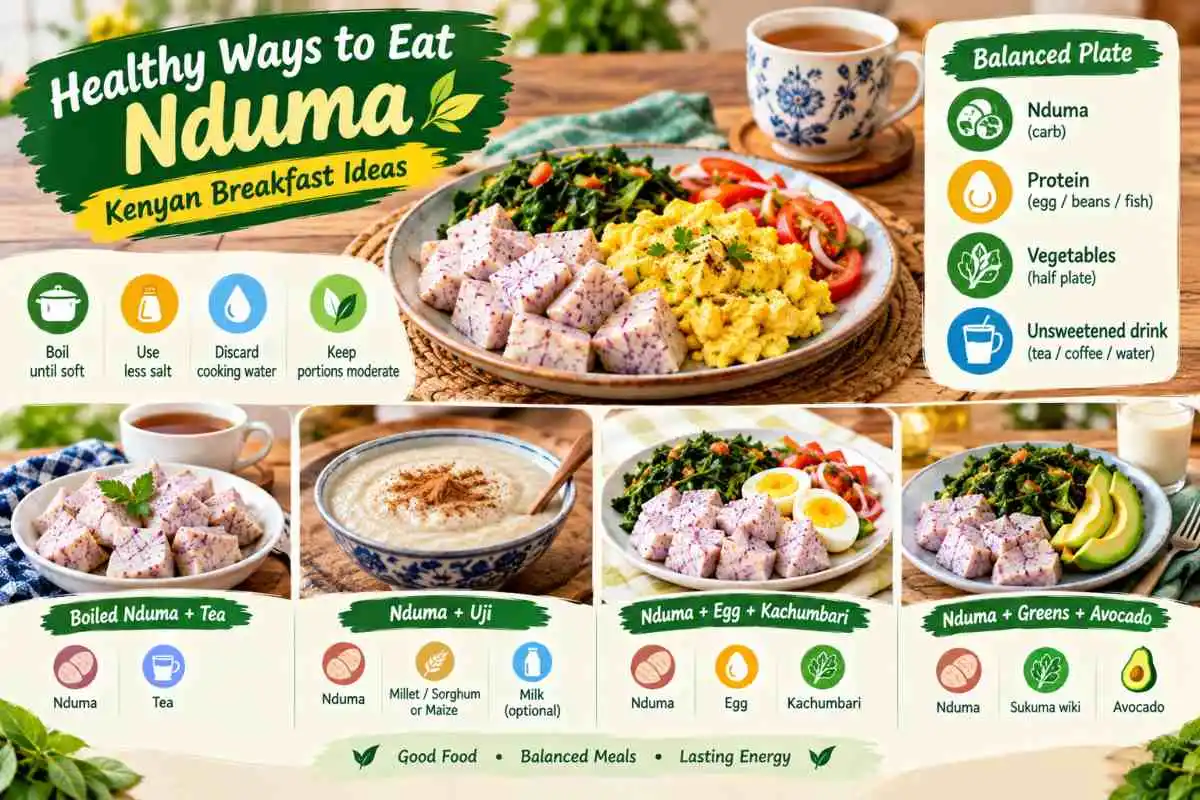
Boiled nduma with tea or uji
Plain boiled nduma is a simple, healthy breakfast, and it pairs well with Kenyan Chai or uji if you keep the sugar low. The classic version needs only three ingredients, nduma, water and salt and The Star describes it as a healthy option. Boil it until completely soft and throw away the cooking water. Kenyans commonly eat it with tea, coffee or milk and the American Diabetes Association advises replacing sugar-sweetened drinks with unsweetened tea or coffee, so go easy on the sugar in your chai.
Uji pairs well because millet and sorghum versions are described as having more staying power than plain maize porridge, thanks to their higher fibre. Sugar in uji is optional and many cooks use milk instead of water for extra protein. A Kenyan study of traditional knowledge found interviewees recommend whole-milled finger millet, maize and sorghum for uji for people managing conditions such as type 2 diabetes. Both nduma and uji are starchy, so if you have them together, keep the nduma portion small.
Pairing with eggs or vegetables
Nduma becomes a complete breakfast when you add protein and vegetables. A cup of cooked taro has only about 1 g of protein and 100 grams has about 0.5 g. One large boiled egg adds about 6.3 g of protein for 78 calories, roughly twelve times as much protein as the same weight of nduma. The ADA’s plate method suggests filling half your plate with non starchy vegetables and a quarter with protein, leaving a quarter for carbohydrate foods and nduma belongs in that carbohydrate quarter.
Kachumbari is a natural vegetable side, since Nairobi street vendors serve boiled nduma with it. Sautéed sukuma wiki and a boiled egg are other options, as is nduma stew cooked with tomatoes, onions or carrots. Kenyan food writers also suggest combining fibre, protein and healthy fats, such as a few slices of avocado, for a breakfast that lasts until lunch. If you don’t eat eggs, beans, milk or fish, also add protein.
Conclusion
Most healthy adults can eat boiled nduma regularly as one starchy staple among several, in a moderate portion. Boiled nduma has about 5.1 g of fibre per 100 grams against 2.3 g for white bread and a glycemic index of 53 against 75, which makes it a better breakfast base than bread or mandazi. It is low in protein, so pair it with eggs, beans, milk or vegetables. No official guideline sets a frequency, but a few portions a week, rotated with ngwaci, cassava and other staples, is a sensible pattern.
People with diabetes can include it as the carbohydrate quarter of the plate and babies can have thoroughly cooked, mashed nduma from around six months. Anyone with kidney stones or kidney disease should check with a doctor or dietitian first, since a cup of cooked taro has about 640 mg of potassium, above the 200 mg per serving the National Kidney Foundation treats as high. How you cook it matters as much as how much you eat. Boil it until completely soft and discard the water, never eat it raw and keep fried nduma occasional, since taro chips have 498 calories per 100 grams against 142 for boiled.
Frequently Asked Questions (FAQs)
Is nduma good for you?
Yes, when boiled and eaten in moderate portions. Cooked nduma provides about 5.1 g of fibre and 484 mg of potassium per 100 grams, with almost no fat. It is low in protein, so pair it with eggs, beans or vegetables.
Is nduma low GI?
Boiled taro has a glycemic index of 53 in the international tables, which is low but close to the 55 cut-off. One separate study measured 60, so portion size and what you eat it with still matter.
Does nduma cause weight gain?
Not by itself. Boiled nduma has 142 calories per 100 grams and almost no fat, so weight gain comes from large portions, frying or eating it on top of your usual breakfast.
Can babies eat nduma?
Yes, from around six months once your baby starts solids, as peeled, thoroughly cooked and mashed nduma. Serve it alongside iron-rich foods, avoid deep-fried nduma and ask your pediatrician if your baby has allergies or feeding difficulties.
Can you eat nduma raw?
No. Raw nduma contains calcium oxalate crystals that can cause burning and swelling in the mouth and throat. Boil it until it’s completely soft, then discard the cooking water.
Is nduma safe with kidney issues?
It depends on the condition, so check with your doctor or kidney dietitian first. Nduma contains oxalate, which matters for kidney stones and a cup of cooked taro has about 640 mg of potassium, which can matter in kidney disease.