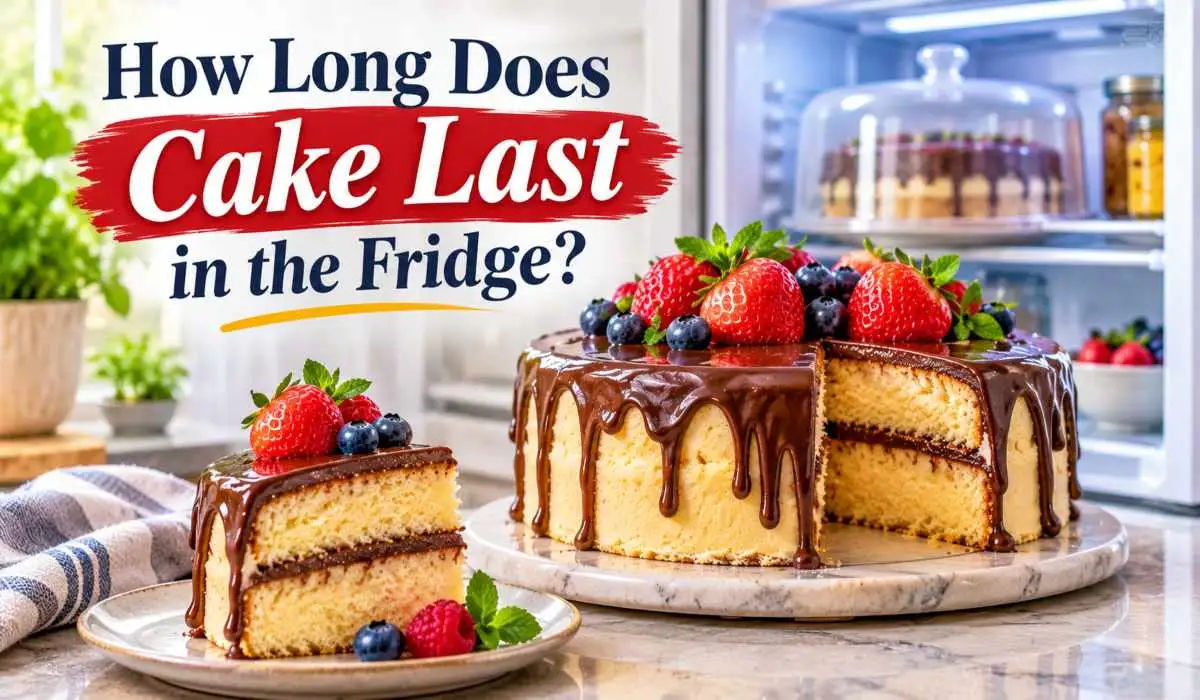
How long does cake last in the fridge? Most cakes last 3 to 4 days in the fridge when they contain cream cheese, whipped cream or custard, and up to 5 to 7 days when they are plain or covered in buttercream and stored airtight. Homemade, frosted and store bought cakes follow this same window, because the filling and frosting matter more than where the cake came from.
How long does cake last in the fridge? It is a question that usually comes up the morning after a party, when half a cake is sitting on the counter and you are not sure it is still safe to eat. The answer shifts with what is inside and on top of the cake, which is why a slice of plain sponge and a slice of birthday cake can be in very different shape by day four.
Dairy based frostings and fillings are the main reason cake spoils faster. USDA guidance says perishable food should not be left out for more than two hours or one hour when the room is above 90°F and leftovers in general are best used within three to four days. Below, you’ll find the timeline for every common type of cake, how to store it so it stays moist and the signs that it is time to throw it out. Once your leftovers are sorted, you can browse more of our desserts for your next bake.
How Long Does Cake Last in the Fridge?
Cake keeps for 3 to 7 days in the fridge, depending on what is in it and on it. Cakes with cream, cream cheese frosting or custard are best eaten within 3 to 4 days, while plain cakes and those with buttercream, fondant or ganache can last up to a week when wrapped well.
The same timeline applies whether the cake is homemade, bakery made or bought from the supermarket, because the ingredients decide how fast it spoils. Count the days from the day the cake was baked or bought and treat the upper end of each range as a limit rather than a target. Cakes are usually at their best texture in the first few days.
Fridge shelf life chart by cake type
This chart gives the typical fridge life for the most common cakes, assuming they are covered or in an airtight container and kept at 40°F (4°C) or below.
| Type of cake |
Fridge life |
| Plain, unfrosted cake (sponge, butter, pound) |
5 to 7 days |
| Buttercream, fondant, or ganache-covered cake |
4 to 7 days |
| Cream cheese frosted cake |
3 to 4 days |
| Whipped cream, custard, or pastry cream cake |
3 to 4 days |
| Cake with fresh fruit topping or fruit filling |
3 to 5 days |
| Cake slices (cut and covered) |
3 to 5 days |
If a cake combines several of these, such as a buttercream cake with a fresh cream filling, use the shortest timeline in the chart. Ranges vary a little between food safety sources, so when in doubt, go with the lower number.
Why refrigeration extends a cake’s life
Refrigeration extends a cake’s life because cold slows the growth of the bacteria and mold that cause spoilage. According to USDA food safety guidance, bacteria can double in 20 minutes when food stays between 40°F and 140°F, so a cake left out on the counter can move past the safe point within hours.
Keeping it at 40°F or below slows that growth dramatically, which is how a cake with perishable dairy can stay safe for days instead of hours. The cold does come with a trade off, since fridge air dries out cake crumb and the frosting can pick up odors from other foods. Wrapping the cake or sealing it in a container protects moisture and flavor, which matters most for cakes without a frosting layer to seal the crumb.
How Long Does Each Type of Cake Last in the Fridge?
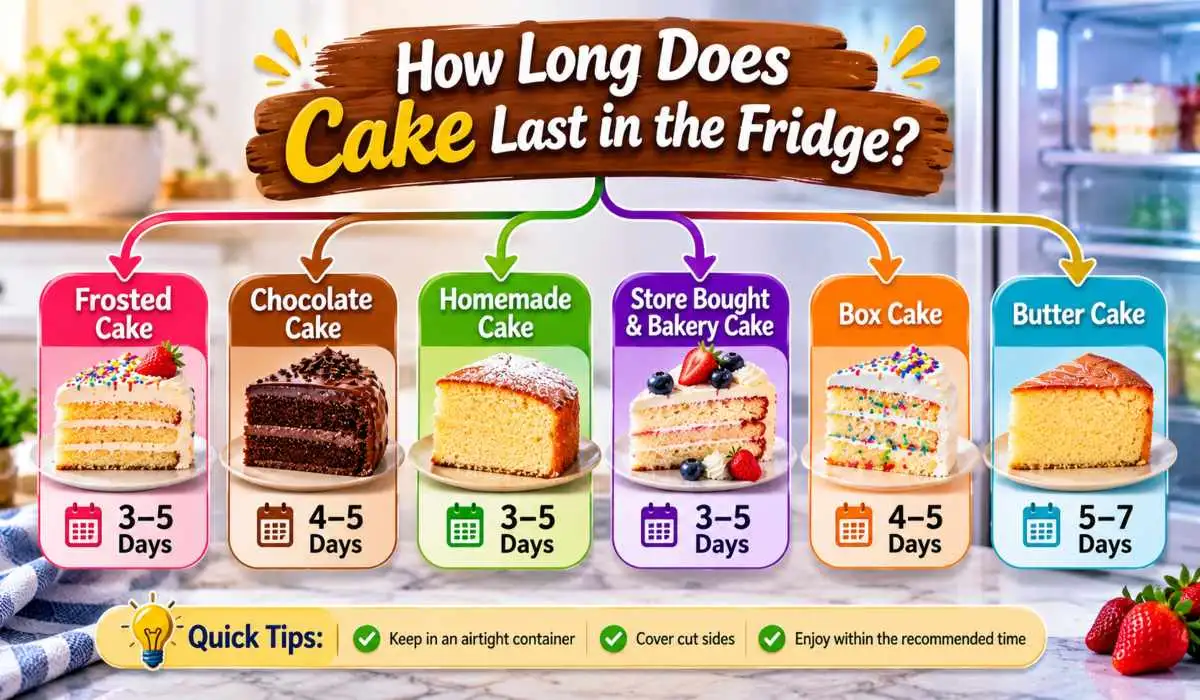
Each type of cake has its own fridge window and it comes down to the frosting, the filling and how moist the crumb is. The sections below cover the common types one at a time, so you can jump to the cake you’re holding.
Birthday cake
A birthday cake lasts 3 to 4 days in the fridge if it’s frosted with cream cheese or whipped cream and up to 5 days with buttercream. Birthday cakes are often layered, filled and decorated, so the most perishable part sets the clock. A Red Velvet Cake with frosting is a good example. It tastes best in the first few days and should go back in the fridge within two hours of serving. Cover the cut side with plastic wrap or parchment or keep the cake in a tall container, so the exposed crumb doesn’t dry out.
Chocolate cake
A chocolate cake keeps for 4 to 5 days in the fridge and the frosting changes that window more than the chocolate does. A ganache or buttercream chocolate cake stays good toward the longer end, while one with whipped cream or a custard layer should be finished within 3 to 4 days. A dense, moist chocolate cake, like this moist chocolate cake recipe, also firms up when cold, so let slices sit out for about 20 to 30 minutes before serving to get back the soft texture.
Homemade cake
A homemade cake lasts 3 to 5 days in the fridge, because it has no preservatives to stretch its shelf life. Kansas State University’s cupboard guidance, as summarized by a cake storage study, gives a prepared cake 3 to 7 days, so the fridge is a safe fallback when you can’t finish it in that time. A plain marble cake with no frosting sits at the longer end if it’s wrapped tightly. A moist cake with mashed fruit, such as Chocolate Chip Banana Cake, is better eaten within about 4 days, since the fruit adds moisture and softens the crumb faster.
Store bought and bakery cake
A store bought or bakery cake lasts 3 to 5 days in the fridge, but check the label or ask the baker first, because commercial cakes vary widely. Kansas State University gives a purchased cake only 1 to 2 days on the shelf, which is why most people refrigerate it and it recommends refrigeration for any purchased cake with a whipped cream or custard filling. Grocery cakes with a shelf stable icing can last a little longer, while bakery cakes made with fresh cream should be treated as perishable. Keep the original box or a cake dome on the cake and count the days from the purchase date.
Box cake
A box cake lasts about 4 to 5 days in the fridge and its shelf life depends on the frosting more than on the mix. Cake mixes produce a standard sponge with no perishable ingredients inside, so an unfrosted or buttercream covered box cake stays good toward the 5 day mark and some sources put plain sponge cakes at up to a week. Canned frosting is more shelf stable than homemade, but a box cake topped with cream cheese or whipped cream follows the shorter 3 to 4 day rule. Wrapped well, the sponge keeps its softness longer than people expect.
Cake with frosting (buttercream vs cream cheese vs whipped cream)
Frosting is the biggest factor in how long a cake lasts in the fridge. Buttercream is the most forgiving, lasting 4 to 7 days because its high sugar and butter content slows spoilage, though egg based versions such as French buttercream always need refrigeration. Cream cheese frosting has a shorter life of 3 to 4 days, since it’s a dairy product that shouldn’t sit out for more than 2 hours.
Whipped cream is the most delicate and should be eaten within 3 days and it needs the fridge even when the cake is only out for serving. A black forest cake is a classic case, with whipped cream and cherries that make it a cake to finish quickly. A cheesecake like this fluffy orange cheese cake is also dairy based, so it always lives in the fridge and is best within about 5 days.
Butter cake
A butter cake lasts 5 to 7 days in the fridge when it’s plain or lightly glazed, making it one of the longest lasting cakes. Butter keeps the crumb tender and holds moisture well, so a classic butter cake stays soft longer than a light sponge. The same is true of a dense pound cake, which keeps its texture all week when it’s wrapped airtight. Both are better on the counter for the first day or two, so move them to the fridge once you’re past that point or if your kitchen is warm. Add buttercream or a cream filling and the timeline drops back to the frosting’s shorter window.
Does Cake Need to Be Refrigerated?
Not always. A cake needs the fridge when it has a perishable filling or frosting, such as cream, custard, fresh fruit or cream cheese and most other cakes stay fresher at room temperature. The deciding factor is almost never the sponge itself, but what has been added to it.
When you should refrigerate
You should refrigerate any cake made with dairy based or moisture rich ingredients, because these spoil quickly at room temperature. That includes cakes filled or frosted with whipped cream, pastry cream, custard or curd, as well as cakes topped with fresh fruit or finished with cream cheese frosting.
Cut fruit leaks juice that speeds up spoilage and cream and custard warm up fast, which is why they belong in the cold. Food safety guidance gives these cakes a short window out of the fridge (about two hours for serving), so it’s best to put them away as soon as the slices have been cut. Cover the cake loosely or place it under a dome so it doesn’t pick up fridge odors and keep it on a lower shelf where the temperature is steadier.
When you can skip the fridge (buttercream, fondant, dense cakes)
You can skip the fridge for cakes covered in buttercream or fondant and for dense cakes with no perishable filling. These stay tender and moist on the counter, while the fridge tends to dry out the crumb and firm up the butter. Kansas State University uses a sugar level of about 65% by weight as the line for a frosting that stays stable at room temperature, which explains why sugar heavy buttercream and fondant hold up so well.
A cake like this can stay in an airtight container or under cake dome for a day or two in a cool kitchen. Dense, buttery cakes, including a Christmas cake, are the most forgiving of all and they keep well on the counter when wrapped tightly. If your kitchen is hot or humid or you want to keep the cake longer than a couple of days, moving it to the fridge is the safer choice.
Does birthday cake need to be refrigerated?
A birthday cake needs to be refrigerated if it has cream cheese frosting, whipped cream, custard or fresh fruit and it can stay on the counter for a day or two if it’s covered in buttercream with no perishable filling. Because birthday cakes are often layered and filled, check the filling as well as the outside. A buttercream cake with a cream or fruit layer still counts as perishable. If the cake has been out during a party, return the leftovers to the fridge once everyone has had a slice rather than leaving them out overnight.
Does chocolate cake need to be refrigerated?
A chocolate cake only needs refrigeration if it has a perishable frosting or filling. A plain chocolate sponge or one covered in ganache or a butter based frosting, can stay at room temperature for a day or two, covered. A simple chocolate frosting made from butter and sugar is stable enough that the cake doesn’t need cold storage right away. Chocolate cakes with whipped cream, custard or cream cheese layers should go in the fridge. Cold storage also firms the crumb and the frosting, so let slices sit out for 20 to 30 minutes before serving to bring back the softness.
How Long Can Cake Stay at Room Temperature?
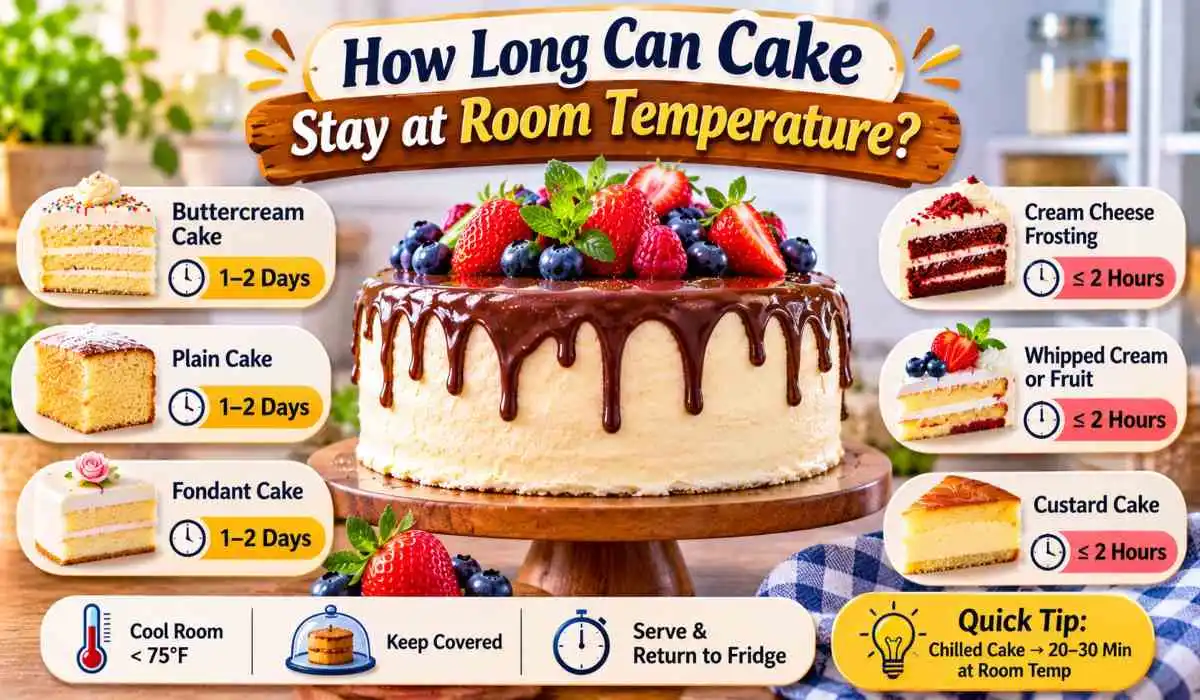
Most cakes can sit out for 1 to 2 days at room temperature if they have no perishable filling or frosting, while cakes with cream, custard or cream cheese should stay out for no more than 2 hours. The clock runs faster in a warm kitchen, so the length of time depends on both the cake and the room.
Cake on the timeline by frosting type
Frosting decides how long a cake can stay on the counter. A cake covered in buttercream with no dairy filling holds for about 1 to 2 days under a dome or in an airtight container and a plain unfrosted cake wrapped well can last a little longer. Fondant covered cakes follow a similar 1 to 2 day window, since the fondant seals the surface and slows drying.
Kansas State University’s cupboard guidance gives a prepared cake 3 to 7 days on the shelf and a purchased cake 1 to 2 days, but those longer figures assume a cake with nothing perishable in it. Cakes finished with cream cheese frosting, whipped cream, custard or fresh fruit are different: they are fine on the counter only while being served and they should be chilled once the slicing is done.
Can you leave cake out overnight?
You can leave a cake out overnight only if it has no perishable ingredients and your kitchen is cool. A plain cake or a buttercream cake made without cream, eggs or milk in the filling is generally fine covered on the counter until morning.
If the buttercream contains cream or eggs or the cake has a cream cheese frosting, whipped cream, custard or fruit layer, it should go into the fridge before bed. A cream cheese frosted cake left out all night is well beyond the safe window and the safest choice is to throw it away instead of trying to rescue it. Heat changes the answer too, so in a hot or humid house even a buttercream cake is better off in the fridge.
How long can cake sit out unrefrigerated?
A perishable cake can sit out unrefrigerated for 2 hours at most or 1 hour if the room is above 90°F. That is the USDA Food Safety and Inspection Service limit for perishable food and it exists because bacteria can double in as little as 20 minutes in the range between 40°F and 140°F.
The two hours include the whole time the cake is out, from the moment it leaves the fridge until it goes back in, so serving, cutting and photographing it all count. A non perishable cake has far more room, usually a day or two. If you’re not sure whether a cake counts as perishable, check the filling and frosting first. When any of them is dairy based, use the two hour rule.
Cake after being out of the fridge (when to take it out before serving)
Take a chilled cake out of the fridge 20 to 30 minutes before serving for slices and up to an hour for a whole buttercream cake. Cold firms up the crumb and hardens butter based frosting, so a short rest at room temperature brings back the soft texture and the flavor.
For cakes with cream cheese, whipped cream or custard, keep that rest closer to 30 minutes, because every minute counts toward the two hour limit. Leave the cake covered while it warms up, which stops the surface from drying and condensation from forming on the frosting. Once everyone has had a slice, return the cake to the fridge right away instead of leaving it out for the rest of the evening.
How to Store Cake in the Fridge (Step by Step)
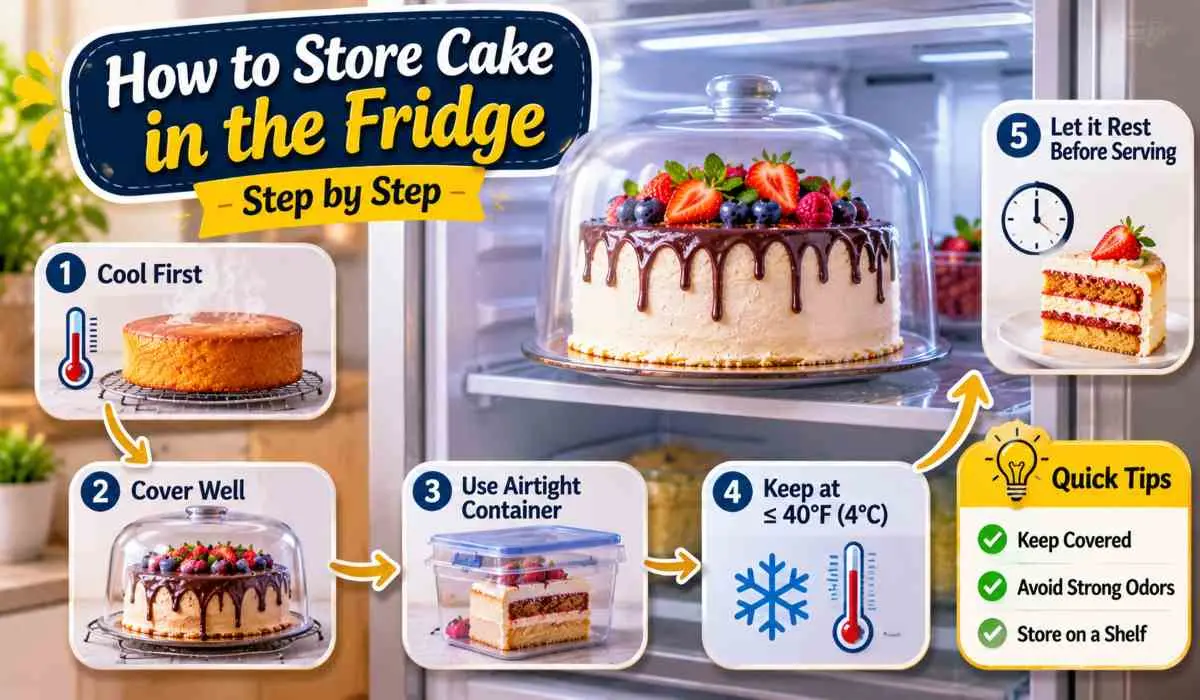
To store cake in the fridge, let it cool completely, cover it so no cut surface is exposed and keep it in a fridge set to 40°F (4°C) or below. The steps differ slightly for a whole frosted cake, slices and unfrosted layers and the sections below cover each one.
Storing a whole frosted cake
A whole frosted cake keeps best when the frosting is chilled first and the cake is then covered loosely. Put the cake in the fridge uncovered for 15 to 20 minutes so the frosting firms up and then cover it with a cake dome, a tall cake carrier or an upturned large bowl.
Covering it after the frosting sets means the wrap or lid won’t drag decorations or swirls with it. Place the cake on a lower shelf, away from the door, where the temperature stays steadier. Cakes with cream cheese, whipped cream or custard benefit most from this spot, since they are the ones with the least room for error.
Storing cut or sliced cake
A cut cake dries out fastest along the exposed crumb, so protect that surface first. Press a fragment of plastic wrap against the cut side or cover it with a spare slice of cake and then put the whole cake under a dome or in a container. If you have only a few slices left, store them in a shallow airtight container with a sheet of parchment between the layers so the frosting doesn’t smear. Slices are best finished within 3 to 5 days and wrapping them individually makes grab and go portions easy.
Storing unfrosted layers
Unfrosted cake layers should be wrapped tightly and stored airtight, because without frosting there is nothing to seal in moisture. Let the layers cool completely, which stops steam from collecting under the wrap and making the surface sticky. Wrap each layer in a plastic wrap, then place the layers together in a zip top bag or an airtight container. Plain layers hold up well this way for several days, which makes the fridge a handy place to keep them when you bake ahead and plan to frost on the day.
Best containers and wrapping
An airtight container or a tightly fitted cake carrier is the best choice for any cake that will stay in the fridge longer than a day. A container with a lid keeps the crumb moist and shields the frosting from air and a tall carrier lets you store a frosted cake without squashing the top. When you only have plastic wrap or foil, wrap the cake in two layers and tuck the ends firmly around the cut edges. For frosted cakes, insert a few toothpicks into the top to hold the wrap away from the surface. Glass and rigid plastic work equally well, as long as the lid closes completely.
Preventing dryness and fridge odors
Cake absorbs the smells of the foods around it and the cold, dry air in the fridge pulls moisture out of the crumb. A tight seal solves both problems, so make sure nothing is left open to the air. Keep the cake away from onions, garlic, leftovers and other strong smelling food and put it on its own shelf where possible. A cake with a dense buttercream layer resists drying better than a plain sponge, which is why unfrosted cake needs the most protection. If a slice does turn a little dry, a brush of simple syrup or a spoonful of cream served alongside can bring it back.
Bringing cake to room temperature before serving
Cake tastes best when it has had a short rest outside the fridge, because cold firms the crumb and dulls the flavor. For a chilled slice, give it about 20 to 30 minutes on the counter and for a whole cake, closer to an hour. Keep the cake covered while it warms, which prevents dry edges and moisture beading on the frosting. Our section on how long cake can sit out has the safe time limits for cakes with cream or cheese, so check that if your cake has perishable layers.
Can You Freeze Cake? How Long Does It Last in the Freezer?
Yes, you can freeze most cakes and they keep their best quality for about 2 to 3 months in the freezer. Unfrosted layers and buttercream cakes freeze best, while cakes with cream cheese, whipped cream or custard lose texture and are better kept for the fridge.
Freezer shelf life
Unfrosted cake layers keep for 2 to 3 months in the freezer and a cake frosted with buttercream or ganache holds up for about the same time when it is wrapped well. Cakes with frosting of cream cheese have a shorter freezer life and Kansas State University’s freezer table, as summarized by Find Homegrown, puts a cream cheese frosted cake at around 1 month.
Whipped cream and custard fillings tend to turn watery after thawing, so those cakes are poor candidates for the freezer. Cake kept at 0°F stays safe indefinitely, but the texture and flavor slowly decline and that is why the time limits are about quality rather than safety. Write the freezing date on the wrapper so you know when the cake has passed its best.
How to wrap and freeze cake
Freeze cake by chilling it, wrapping it airtight and sealing out as much air as possible. Start with a fully cooled cake, since warmth creates steam that turns into ice crystals under the wrap. For a frosted cake, set it in the freezer uncovered for about an hour until the frosting is firm, which keeps the wrap from sticking to the surface. Then wrap cake in two layers of wrap, add a layer of foil and place it in freezer bag or an airtight container. Unfrosted layers are wrapped the same way, individually, so you can pull out only what you need. Slices freeze well too when each one is wrapped separately, which makes it easy to enjoy a single portion later.
Thawing without ruining texture
Thaw cake slowly in the fridge, still wrapped, so the surface doesn’t collect condensation. A whole cake needs 6 to 8 hours or overnight in the fridge and a single slice is ready in about an hour or two. Leave the wrapping on during thawing, because it keeps moisture on the cake instead of letting it form on the frosting.
Once thawed, let the cake rest at room temperature for about 20 to 30 minutes to soften the crumb before serving. Unfrosted layers can be thawed on the counter, still wrapped, in about an hour, which is handy when you plan to frost them on the same day. Avoid refreezing a cake after it has thawed, since each freeze and thaw cycle dries it out and weakens the texture.
Cake Shelf Life Cheat Sheet (Fridge vs Counter vs Freezer)
Cake lasts 1 to 2 days on the counter, 3 to 7 days in the fridge and almost 2 to 3 months in the freezer, as long as it has no perishable filling or frosting. Cakes made with cream cheese, whipped cream or custard are the exception, since they can stay out for only about 2 hours and have a shorter life in both the fridge and the freezer. The table below puts every common cake type side by side so you can find your answer quickly.
| Type of cake |
Counter |
Fridge |
Freezer |
| Plain, unfrosted cake (sponge, butter, pound) |
1 to 2 days |
5 to 7 days |
2 to 3 months |
| Buttercream or ganache-covered cake |
1 to 2 days |
4 to 7 days |
2 to 3 months |
| Fondant-covered cake |
1 to 2 days |
4 to 7 days |
2 to 3 months |
| Cream cheese frosted cake |
2 hours |
3 to 4 days |
About 1 month |
| Whipped cream, custard, or pastry cream cake |
2 hours |
3 to 4 days |
Not recommended |
| Cake with fresh fruit topping or filling |
2 hours |
3 to 5 days |
Not recommended |
| Cheesecake |
2 hours |
About 5 days |
1 to 2 months |
| Cut slices (covered) |
Same as the whole cake |
3 to 5 days |
2 to 3 months, wrapped individually |
The 2 hour limit is the USDA Food Safety and Inspection Service rule for perishable food and it drops to 1 hour when the room is above 90°F. If a cake combines several types, such as a buttercream cake with a cream filling, follow the shortest time in its row. These ranges are for cake stored at 40°F or below in the fridge and at 0°F in the freezer and the freezer times describe the best quality rather than safety. For bakes that fit comfortably within these windows, browse our easy cake recipes.
Conclusion
Cake lasts about 3 to 4 days in the fridge when it has cream cheese, whipped cream or custard and up to a week when it is plain or covered in buttercream. Cool it fully, cover it well and return perishable cakes to the fridge within two hours of serving. If you can not finish it in time, wrap it tightly and freeze it. For more cakes worth baking, visit Devine Dishes.
Frequently Asked Questions (FAQs)
How long can cake last in the fridge with frosting?
A frosted cake lasts 3 to 4 days in the fridge if the frosting is cream cheese or whipped cream and 4 to 7 days with buttercream, fondant or ganache. Cover it well so the frosting doesn’t absorb fridge odors.
How long does store bought cake last in the fridge?
Most store bought cakes keep for 3 to 5 days in the fridge, counted from the purchase date. Cakes with fresh cream or custard are best finished sooner, so check the label or ask the bakery.
How long is homemade cake good for in the fridge?
Homemade cake is good for about 3 to 5 days in the fridge, since it has no preservatives. A plain, tightly wrapped cake can reach the longer end of that range.
Should butter cake be refrigerated?
Plain butter cake does not need the fridge for the first day or two and it stays soft on the counter when covered. Refrigerate it after that or right away if it has a cream filling or if your kitchen is warm.
How long can a cake be out of the fridge?
A cake with cream cheese, whipped cream or custard can be out for 2 hours at most or 1 hour above 90°F, according to USDA guidance. A buttercream or plain cake can stay out for 1 to 2 days when covered.
Does cake expire?
Yes, cake has a limited shelf life, though it rarely has a hard expiration date. Bakery and boxed cakes may carry a best by date, while homemade cake is best judged by its storage time, smell and appearance.
Can cake go bad in the fridge?
Yes, cake can spoil in the fridge once it passes its recommended storage time and mold and sour smells are the usual signs. Cold slows spoilage but does not stop it, so throw out any cake that looks or smells off.
Disclaimer: Storage times on this page are general guidelines based on USDA Food Safety and Inspection Service guidance and typical home conditions. Actual shelf life depends on the ingredients, how the cake was handled and your fridge temperature. If a cake looks, smells or tastes off, or you are unsure how long it has been out, throw it away. Pregnant women, older adults, young children and people with weakened immune systems should be extra careful with dairy- and egg-based cakes. This is general information, not professional food safety advice.