How long does cooked beef last in the fridge? Cooked beef and other cooked meat stay safe for 3 to 4 days in a refrigerator set to 40°F (4°C) or colder, according to the USDA Food Safety and Inspection Service. If you won’t finish it in that window, freeze it at 0°F (−18°C), where it stays safe indefinitely, though quality is best within 2 to 6 months. Put cooked beef in the fridge within 2 hours of cooking, or within 1 hour if the room is above 90°F.
Most of us have stared into the fridge at a container of leftover roast or steak and wondered whether it’s still fine to eat. The question of how long cooked beef lasts in the fridge matters more than it seems, because spoiled meat does not always look or smell bad. The CDC estimates that foodborne illness affects about 48 million Americans every year and leftovers kept too long are a common, avoidable cause.
The 3 to 4 day guideline applies whether you are storing roast beef, sliced steak, meatballs, shredded brisket or any other cooked meat. The clock starts the day the beef is cooked, not the day you put it away, which is why cooling it quickly and storing it properly matters as much as the number of days.
The sections below explain how to store cooked beef so it reaches the full four days, how to tell when it has gone bad and what to do if you need it to last longer.
Fridge Storage Times for Cooked Beef
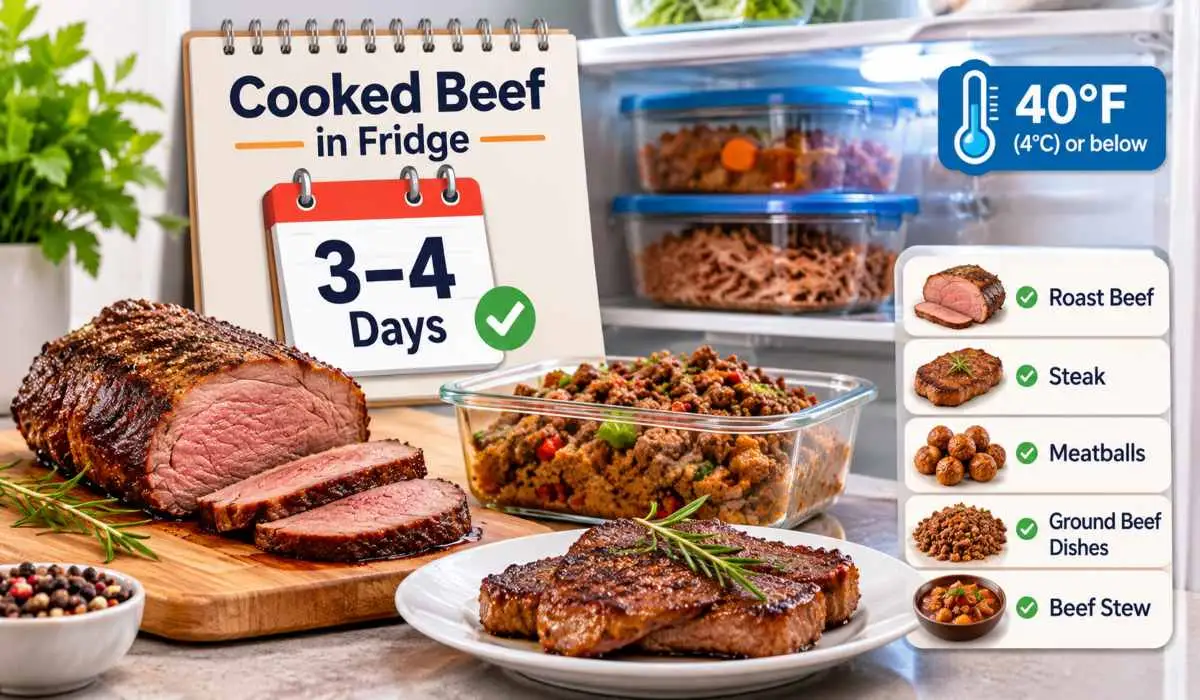
The USDA says cooked beef keeps safely for 3 to 4 days in a refrigerator held at 40°F (4°C) or below. That window is the same for roast beef, steaks, meatballs and most other cooked beef dishes and it covers the other cooked meats you might be storing alongside them.
Cooked beef and cooked meat
Cooked beef, pork, lamb and veal all share one refrigerator limit, 3 to 4 days, counted from the day the meat was cooked. The rule applies to the whole category because the risk is the same. Cooking kills the bacteria on raw meat, but new bacteria settle on the surface during slicing, handling and cooling and those can multiply even at fridge temperatures, only more slowly. By day 5, the odds of a harmful bacterial load rise enough that the USDA draws its line at four days, even when the meat still looks and smells normal.
Cooked roast beef, steak, ground beef dishes and leftovers
Cuts and cooking styles do not change the timeline. A cooked roast, a seared steak, shredded brisket and sliced deli style roast beef made at home all follow the 3 to 4 day rule. Ground beef dishes such as meatloaf, taco meat, burgers and chili with beef fall under the same limit, as do casseroles and soups that contain cooked beef.
A dish is only as shelf stable as its most perishable ingredient, so a pot of beef stew gets the same four days as a plain steak. If a leftover mixes beef with rice, pasta or vegetables, treat the whole container as cooked beef and count the days from the day it was made.
A quick chart cooked beef vs other cooked meats and leftovers
| Food (cooked) |
Refrigerator (40°F or below) |
Freezer (0°F) for best quality |
| Beef, pork, lamb, veal |
3 to 4 days |
2 to 6 months |
| Ground beef and meat dishes |
3 to 4 days |
2 to 3 months |
| Poultry (chicken, turkey) |
3 to 4 days |
2 to 6 months |
| Soups and stews with meat |
3 to 4 days |
2 to 3 months |
| Cooked fish and shellfish |
3 to 4 days |
2 to 3 months |
| Casseroles and mixed leftovers |
3 to 4 days |
2 to 3 months |
Frozen food held at 0°F stays safe indefinitely, so the freezer column describes how long the quality holds up, not how long the food is safe.
Why the 40°F fridge temperature matters
Bacteria grow fastest between 40°F and 140°F, a range the USDA calls the danger zone and in that range their numbers can double in as little as 20 minutes. A fridge at or below 40°F slows that growth sharply, which is what makes the 3 to 4 day window possible.
A fridge that runs even a few degrees warmer shortens the safe time, so the four days no longer hold. An inexpensive appliance thermometer is the only reliable way to check, because most refrigerators’ dial settings don’t show the actual temperature. Keep it on a middle shelf, away from the door and adjust the setting if it reads above 40°F.
How Long Can Cooked Beef Sit Out Before the Fridge?
Cooked beef should sit at room temperature for no more than 2 hours before it goes into the fridge or just 1 hour if the temperature is beyond 90°F (32°C). Past that point, bacteria can reach levels that reheating won’t make safe, so the beef is best thrown away.
The 2 hour rule (1 hour above 90°F)
The USDA sets a simple limit for any perishable food, cooked beef included, two hours total at room temperature, counted from the moment it leaves the heat source. On a hot day, at an outdoor barbecue or in a warm kitchen where the temperature is above 90°F, that shrinks to one hour.
The clock is cumulative, so time spent on the buffet table, in the car on the way home and on the counter while you cleared the plates all add up. If you’re unsure how long a dish has been out, treat the limit as reached. Slicing a large roast into smaller portions and spreading it in shallow containers helps it cool faster once it goes into the fridge, so you can start the clock on safe storage sooner.
The danger Temperature zone (40°F to 140°F) and bacterial growth
The 2 hour limit exists because of the temperature range the USDA calls the danger zone, 40°F to 140°F (4°C to 60°C). In that range, bacteria multiply quickly and under good conditions their numbers can double in as little as 20 minutes. Cooking kills the bacteria on raw beef, but organisms from hands, utensils, cutting boards and the air settle on cooked meat afterward and a warm, moist piece of beef is an ideal place for them to grow.
Some bacteria, such as Bacillus cereus and Staphylococcus aureus, also produce toxins that survive reheating, which is why warming up beef that sat out too long doesn’t make it safe. Keeping hot beef above 140°F or cold beef below 40°F stays outside the danger zone and that’s the principle behind chafing dishes, slow cookers on the warm setting and ice packed coolers.
Leaving beef out overnight
Cooked beef left out overnight should be thrown away, even if it looks, smells and tastes normal. Eight hours or more at room temperature is far beyond the 2 hour limit and the bacteria and toxins that build up can’t be seen or smelled. Reheating, however thoroughly, doesn’t destroy heat stable toxins and neither does cooking it again in a stew or casserole.
The same applies to beef left in a switched off oven, a closed slow cooker or a cooler that has lost its ice. If you find a dish that was out overnight, the safest option is to discard it and the cost of a few slices of roast is small compared with a case of food poisoning.
How to Store Cooked Beef So It Lasts the Full 3–4 Days
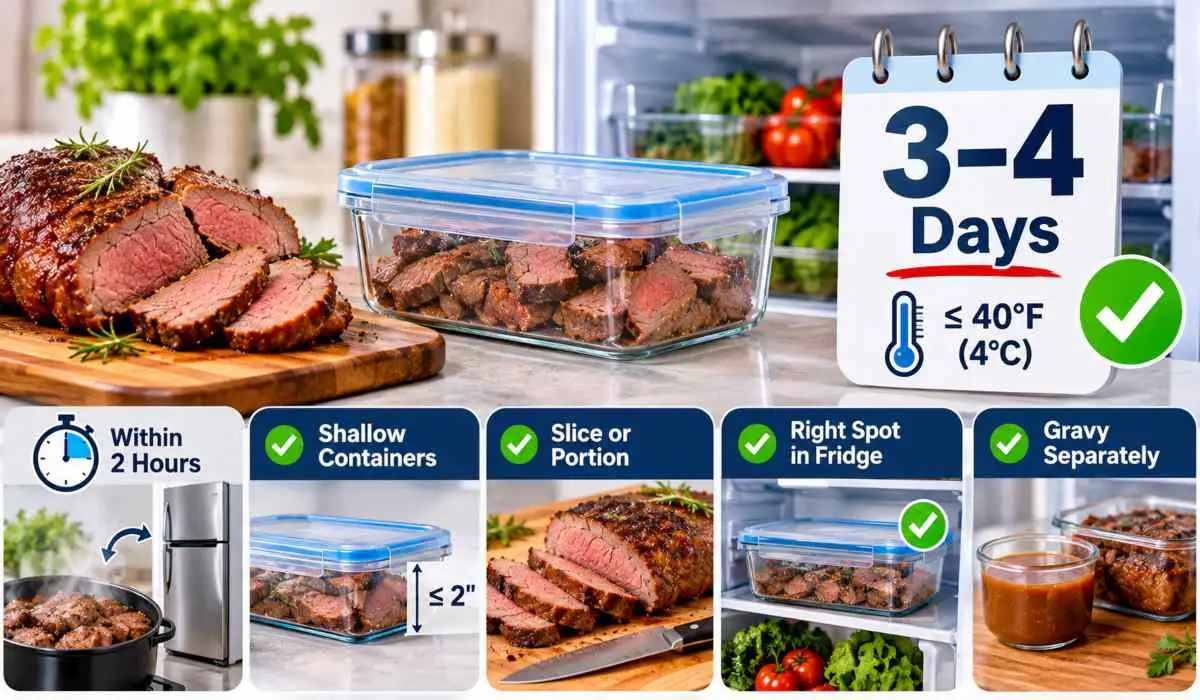
To get the full 3 to 4 days out of cooked beef, refrigerate it within 2 hours of cooking, pack it in shallow airtight containers and keep it on a shelf where the fridge stays at 40°F (4°C) or below. How quickly the meat cools matters as much as the container it sits in, because bacteria gain the most ground in the hours right after cooking.
Cool and refrigerate within 2 hours
Cooked beef goes into the fridge within 2 hours of leaving the heat or within 1 hour if the temperature in the room exceeds 90°F. You don’t need to wait for it to cool on the counter first. The USDA states that hot food can go straight into the refrigerator and that waiting for it to cool on its own only keeps it in the danger zone longer. For a big batch, such as a full pot of beef stew, the center can stay warm for hours, so divide it up before storing. Set a timer when you sit down to eat and pack the leftovers away before you clear the rest of the table.
Shallow, airtight containers vs foil or wrap
Shallow, airtight containers are the better choice, because they let the beef cool quickly and the seal keeps out air, fridge odors and bacteria from other foods. The USDA recommends containers no more than about 2 inches deep, since a thin layer chills through to the center much faster than a deep one.
Foil, plastic wrap and freezer bags are acceptable for short term storage, but they rarely seal as tightly and foil can tear around sharp bones or edges. If you do use wrap, press it close to the surface of the meat and cover it fully. Glass or hard plastic containers with locking lids are the easiest to stack and the most reliable for the full four days.
Slicing or portioning large roasts before storing
Large roasts, briskets and whole cuts hold heat in the center for a long time, so cut them into smaller pieces before storing. Slicing a roast into portions or cutting it into pieces of about 3 inches thick or less lets the heat escape faster and brings the whole piece below 40°F sooner.
Portioning also helps you reheat only what you need, which matters because food that is warmed and cooled repeatedly gains more chances for bacteria to grow. For a roast you plan to use across several meals, divide it into meal sized containers right away rather than storing it whole and carving from it each day.
Where to place it in the fridge
Place cooked beef on a middle or lower shelf toward the back, where the temperature stays steadiest. The fridge door is the warmest and most variable spot, since it swings in temperature every time it opens, so it isn’t a good place for leftovers. Store cooked beef on a shelf above raw meat, poultry and fish, never below, so that raw juices can’t drip onto food that won’t be cooked again. Leave a little space around the containers so cold air can circulate, because a packed fridge cools unevenly. A fridge thermometer on the same shelf will confirm it holds 40°F or below.
Storing with gravy or sauce
Beef stored with gravy, broth or sauce follows the same 3 to 4 day limit and it benefits from being stored in the same container, since the liquid keeps the meat from drying out. Cool the gravy as quickly as the meat by dividing it into shallow containers rather than leaving it in a deep pot or gravy boat.
USDA guidance for leftover sauces and gravies is shorter than for the meat itself, with gravies and meat broths recommended for just 1 to 2 days in the fridge, so if you stored the beef together with gravy, plan to finish the whole container within that tighter window. If you want the full four days for the beef, store the gravy separately and reheat it to a rolling boil before serving.
Does the Clock Start When You Cook It?
Yes. The 3 to 4 day countdown for cooked beef begins on the day it was cooked, not the day you moved it to the fridge or the day you first noticed it. Counting from the cooking date keeps you honest about how long the meat has really been sitting and it’s the simplest way to avoid eating leftovers past their safe window.
How to count the 3–4 days
Count the day the beef was cooked as day zero, then add one day for each midnight that passes. Beef cooked on Monday evening is at day one on Tuesday, day two on Wednesday, day three on Thursday and day four on Friday. Friday is the last day to eat it and by Saturday it should be thrown out.
The conservative approach is to treat day three as the target and day four as the absolute limit, because the USDA gives a range rather than a single guaranteed number and a fridge that runs slightly warm or a container that was opened often will shorten the real window.
Reheating doesn’t reset the clock. Warming leftovers on day two and putting them back doesn’t buy you extra days and the same piece of beef shouldn’t go through repeated rounds of cooling and warming. If the beef sat out for part of the first day or was cooked a day before you stored it, the count still starts at the original cooking time and the shorter end of the range is the safer bet.
Labeling and dating leftovers
Writing the cooking date on every container is the most reliable way to track the clock, since memory fails quickly once a few leftovers pile up. Use masking tape or a freezer safe label and a permanent marker and write the date the beef was cooked along with what it is, such as “Roast beef, Nov 3.” Some people prefer to write the use by date directly, for example “Eat by Nov 6,” so no math is needed when they open the fridge.
Place the label on the lid and the side of the container so it can be read from any angle and put older containers at the front of the shelf so they get eaten first. A weekly fridge check, with a quick look at every label, catches anything approaching its limit. Research from the USDA own consumer studies has found that many households don’t track leftover dates at all, which is why a label is such a simple and effective habit. Treat any container with no date as unknown and discard it, since guessing is exactly how spoiled leftovers end up on a plate.
How to Tell if Cooked Beef Has Gone Bad
Spoiled cooked beef usually gives itself away through a sour or off smell, a slimy or sticky surface, a dull gray green color or visible mold. But the absence of these signs doesn’t prove the beef is safe, so the date matters more than your senses, once cooked beef has been in the fridge longer than 3 to 4 days, throw it out even if nothing seems wrong.
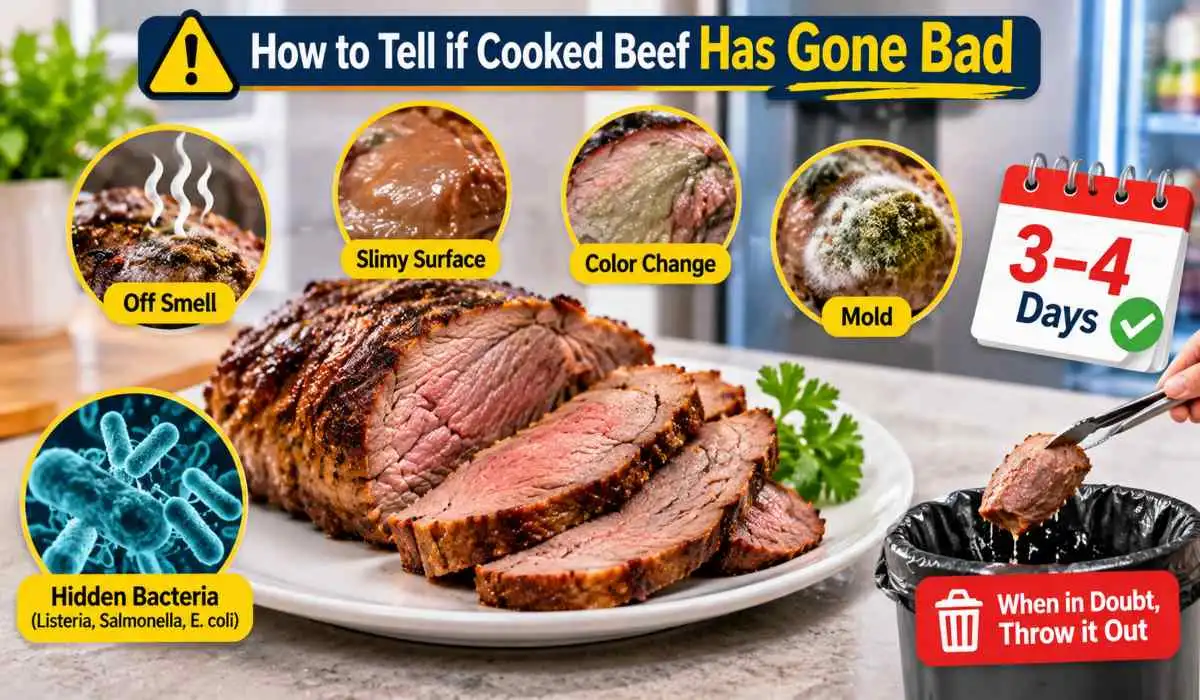
Smell, slime, color change and mold
Fresh cooked beef smells savory and meaty, so any sharp, sour, ammonia like or rotten odor means the meat should go in the trash. Touch is the second clue, beef that feels tacky, sticky or slick on the surface is carrying a bacterial film and rinsing it won’t fix that. Color is the third.
Cooked beef naturally ranges from brown to gray, so color alone can mislead, but a dull gray green tint, dark patches or an unusual sheen suggests the meat has turned. Mold appears as fuzzy white, green, black or blue spots. If you see it, discard the whole portion, because mold threads spread through soft, moist food well beyond the visible spot. Never taste a questionable piece to check it, since a small bite is enough to make you ill.
Why “it looks fine” isn’t enough (bacteria you can’t see)
Cooked beef can look, smell and taste perfectly normal and still make you sick. The USDA explains that the bacteria which cause food poisoning, such as Listeria,Salmonella and E. coli, don’t change the look or smell of food and only spoilage organisms produce the off odors and textures people rely on.
Listeria is a special concern with leftovers because it can keep multiplying at refrigerator temperatures. The CDC estimates that Listeria causes about 1,600 illnesses in the United States each year and it is especially dangerous for pregnant women, older adults and people with weakened immune systems. That is why the USDA bases its guidance on storage time and temperature rather than appearance and why a 5 day old piece of beef that looks fine is still a risk.
When in doubt, throw it out
If you can’t remember when the beef was cooked, if it has no date label or if it sat out longer than 2 hours before refrigeration, discard it. The same goes for any beef that has passed the 3 to 4 day mark. The cost of replacing a few slices of roast or a small container of leftovers is tiny compared with a bout of food poisoning, which can bring days of vomiting, diarrhea and fever. Don’t give questionable beef to pets either, since they can get sick from spoiled meat too. Wrap it securely before putting it in the bin so it doesn’t attract pests or contaminate other waste and wash the container with hot, soapy water before using it again.
Cooked Beef in the Freezer
Cooked beef stays safe in the freezer indefinitely when held at 0°F ( 18°C), but it tastes best if eaten within 2 to 6 months. Freezing is the simplest way to stretch leftovers past the 3 to 4 day fridge window, as long as the beef goes in before that window closes.
How long cooked beef keeps in the freezer
The USDA states that food kept constantly at 0°F stays safe indefinitely, because freezing stops bacteria from growing. What changes over time is quality, not safety. Cooked beef held for 2 to 6 months keeps its best flavor and texture and beyond that it gradually dries out, picks up off flavors and turns tough, though it remains safe to eat.
Dishes made with ground beef, such as meatloaf or beef in soups and stews, are usually given a shorter quality window of about 2 to 3 months. A freezer thermometer is worth the few dollars, since many home freezers run warmer than 0°F without anyone noticing and a warmer freezer shortens the quality window.
How to freeze and thaw it safely
Freeze cooked beef within the 3 to 4 day fridge window and the sooner the better. Cool it promptly, divide it into meal sized portions and pack it in airtight containers or freezer bags with as much air pressed out as possible. Air exposure is what causes freezer burn, which won’t make the beef unsafe but leaves dry, grayish patches and a stale taste. Label each package with the contents and the cooking date so you can use the oldest first.
For thawing, the USDA recommends three safe methods, in the refrigerator, in a bowl of cold water that you change every 30 minutes or in the microwave. Fridge thawing is the gentlest and keeps the beef cold throughout, but it takes planning, since a small package needs several hours and a large roast needs a day or more. Beef thawed in cold water or the microwave should be reheated and eaten right away and it should never be thawed on the counter. Once thawed in the fridge, cooked beef can be kept another 3 to 4 days before eating and it should be reheated to 165°F (74°C).
Can you freeze beef that has already been in the fridge for a few days?
Yes, you can freeze cooked beef that has spent a few days in the fridge, as long as it is still within the 3 to 4 day limit and has been stored properly. Freezing doesn’t kill the bacteria already present, it only pauses their growth, so beef that was already close to spoiling goes into the freezer in the same condition and comes out the same way.
That is why the best practice is to freeze leftovers on the day you cook them or the next day, not on day four. Quality also declines a little with each day in the fridge before freezing, so beef frozen early will taste better when thawed. If the beef has passed the 4 day mark or has sat out longer than 2 hours, don’t freeze it. Throw it out instead. Freezing leftovers that were already thawed in the fridge is generally safe too, though each freeze and thaw cycle costs some moisture and texture.
Raw Beef vs Cooked Beef in the Fridge
Raw beef and cooked beef don’t share a fridge timeline. Raw steaks and roasts keep for 3 to 5 days and raw ground beef for just 1 to 2 days, while cooked beef keeps for 3 to 4 days, all at a fridge temperature of 40°F (4°C) or below, according to USDA guidance.
Raw steaks, roasts and chops 3–5 days
Raw steaks, roasts and chops can stay in the refrigerator for 3 to 5 days after you bring them home and the USDA counts that window from the purchase date rather than the “sell by” date, as long as the meat was kept cold. Note that chops here refers to cuts like pork or lamb chops, which follow the same rule as beef steaks and roasts.
The label date on the package is a guide for the store, not a safety cutoff, so a steak bought two days before its sell by date is still good for the full 3 to 5 days at home if it has stayed cold. Keep the meat in its original packaging or rewrap it tightly and store it on the bottom shelf in a tray or on a plate so raw juices can’t drip onto other foods. If you won’t cook it within 5 days, freeze it.
Raw ground beef 1–2 days
Raw ground beef must be cooked or frozen 1 to 2 days of purchase, which is a much tighter window than for whole cuts. The same goes for other ground meats, such as ground pork, lamb and veal. Grinding spreads whatever bacteria were on the surface of the meat throughout the entire batch and it greatly increases the surface area where new growth can happen.
For that reason, ground beef spoils faster and carries a higher risk if it is undercooked. The USDA recommends cooking ground beef to an internal temperature of 160°F (71°C), measured with a food thermometer, because color alone is not a reliable sign of doneness. If you bought more than you can use in two days, portion it and freeze it the day you buy it.
Why cooked and raw beef have different timelines
The timelines differ because cooking and grinding change the risks in different ways. Cooking kills most of the bacteria on raw beef, but cooked meat gets recontaminated through handling and the air and it is usually stored in smaller portions and for a shorter stretch than a whole raw cut, which leads to the 3 to 4 day guideline. Whole raw cuts have bacteria mainly on the outside, which searing and roasting destroy and that is part of why they can sit longer in the fridge before cooking.
Ground beef is the exception, with bacteria mixed throughout, which is why it has the shortest window of the three. The CDC estimates that about One out of every six individuals in the United States becomes ill due to foodborne diseases annually and raw and undercooked beef are among the foods tied to outbreaks of E. coli, which is why these time limits are worth following closely. In short, the closer beef is to being raw and ground, the faster the clock runs and once it is cooked, the clock restarts at 3 to 4 days from the cooking date.
Reheating Leftover Cooked Beef Safely
Leftover cooked beef is safe to eat once it has been reheated to an internal temperature of 165°F (74°C), measured with a food thermometer. Reheat only what you plan to eat and do it within the 3 to 4 day fridge window, since warming beef up doesn’t make an old batch safe again.
Reheat to 165°F (74°C)
The USDA advises reheating all leftovers to 165°F, which is higher than the 145°F minimum for freshly cooked whole cuts of beef, because leftovers may have picked up bacteria while they cooled and sat in storage. Reheating is the last safety step and the only dependable way to confirm it worked is a food thermometer, since color and steam can both mislead.
Insert the probe into the thickest part of the beef or the center of a dish like stew or casserole and check a few spots if the portion is large. Heat should reach the middle, not just the surface and the beef should be steaming hot throughout. Gravies, sauces and soups should be brought to a full rolling boil. Reheating won’t rescue beef that has gone past its storage limit or sat out too long, because some bacterial toxins survive heat, so the date and storage conditions still come first.
Microwave, oven and stovetop reheating tips
Each method works for beef, as long as the food reaches 165°F and the right choice depends on the cut and how much texture you want to keep.
In the microwave, spread the beef in a single even layer on a microwave safe dish, add a spoonful of broth or water and cover it loosely to hold in steam. Stir or rotate halfway through, because microwaves heat unevenly, creating areas that remain cold where bacteria may thrive. Let the dish stand for a minute or two afterward so the heat evens out, then check the temperature in several places.
The oven suits larger pieces like sliced roast or meatloaf. Set it to about 325°F, place the beef in a covered dish with a little liquid and heat until the center reaches 165°F. It takes longer than the microwave, but it keeps the meat tender and avoids rubbery edges.
On the stovetop, warm sliced or shredded beef gently in a skillet on medium to low heat adding some broth or gravy, stirring often. This works well for stews, stir fries and shredded beef and it is easy to bring any liquid to a boil. Avoid high heat, which toughens the meat and dries it out before the center is hot.
Can you reheat beef more than once?
You can reheat cooked beef more than once from a food safety standpoint, but it’s best not to. The USDA says leftovers can be reheated multiple times, yet every round of cooling and warming gives bacteria another chance to grow and costs the meat more moisture and flavor.
The safest habit is to portion leftovers before storing them and reheat only the amount you will eat in one sitting, returning the rest to the fridge untouched. If you do reheat a portion and have some left over, cool it and refrigerate it promptly within 2 hours and count it as part of the original 3 to 4 day window, not a fresh one. Beef that has been reheated and left sitting out should be thrown away.
Conclusion
Cooked beef stays safe in the fridge for 3 to 4 days at 40°F (4°C) or below, counted from the day it was cooked. Refrigerate it within 2 hours, store it in shallow airtight containers and reheat it to 165°F (74°C) before eating. If you can’t finish it in time, freeze it at 0°F ( 18°C), where it stays safe indefinitely and tastes best within 2 to 6 months.
Looks and smell aren’t reliable tests, so when you’re unsure how long something has been stored, throw it out. This guide is general food safety information based on USDA recommendations and calories will vary with the ingredients in any recipe you make. For easy home cooking ideas, explore the recipes at Devine Dishes.
Frequently Asked Questions (FAQ)
How long does cooked beef last in the fridge?
Cooked beef lasts 3 to 4 days in a refrigerator set to 40°F (4°C) or below, according to the USDA. Count from the day it was cooked and refrigerate it within 2 hours of cooking (1 hour if room is over 90°F) so it can reach the full four days.
Is cooked beef good after 5 days? After a week?
No. Cooked beef past the 4 day mark should be thrown away and that includes beef at 5 days and at a week. Harmful bacteria such as Listeria can keep growing at fridge temperatures without changing how the meat looks or smells, so a piece that seems fine can still make you sick. If you won’t eat it within four days, freeze it before the window closes.
How long is cooked beef good in the freezer?
Cooked beef stays safe indefinitely at 0°F ( 18°C) and it keeps its best taste and texture for about 2 to 6 months. Dishes with ground beef, soups and stews are usually best within 2 to 3 months. Past those windows the beef is still safe but may turn dry, tough or freezer burned.
How long can cooked meat stay in the fridge?
Cooked meat, including beef, pork, lamb, veal and poultry, stays safe for 3 to 4 days in a fridge at 40°F or below. The same limit applies to leftovers that mix cooked meat with rice, pasta or vegetables. Treat the whole container as cooked meat and count from the day it was made.
Can you eat cooked beef that was left out overnight?
No. Cooked beef left out overnight should be thrown away, even if it looks and smells normal. The USDA limit is 2 hours at room temperature or 1 hour above 90°F and an overnight stretch is far beyond that. Some bacterial toxins survive reheating, so warming the beef again won’t make it safe.
Does cooked roast beef last longer than other cooked beef?
No. Cooked roast beef follows the same 3 to 4 day rule as steak, meatballs, brisket and other cooked beef. A large roast can cool slowly in the center, so slice or portion it into shallow containers before refrigerating to help the whole piece chill quickly.
How long does beef last in the fridge raw vs. cooked?
Raw steaks and roasts keep for 3 to 5 days, raw ground beef for 1 to 2 days and cooked beef for 3 to 4 days, all at 40°F or below. Ground beef has the shortest window because grinding spreads surface bacteria throughout the meat. Once beef is cooked, the 3 to 4 day clock starts from the cooking date.
Does vacuum sealing extend the fridge life of cooked beef?
Not reliably. Vacuum sealing slows spoilage from oxygen loving organisms and prevents drying, but it doesn’t make the 3 to 4 day USDA guideline longer for homemade leftovers. Some bacteria, including Listeria, can still grow in low oxygen packaging at refrigerator temperatures. For longer storage, vacuum seal the beef and freeze it, where the seal also helps prevent freezer burn.